Newsletter Sign Up

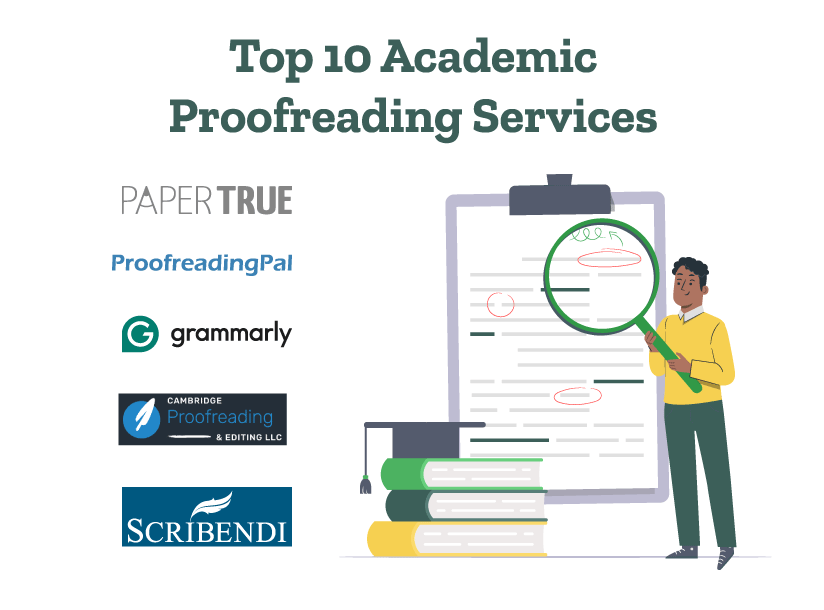
Top 10 Academic Proofreading Services (2025 Update)

Academic writing is challenging for multiple reasons. Colleges and universities often assign topics that require extensive research. They also demand adherence to strict formatting and stylistic guidelines. These requirements can overwhelm anyone! 

As a result, academic proofreading services have gained popularity in recent years, offering students the support they need to refine their writing and meet academic standards. In this guide, we explore the top ten academic proofreading services available today. 

Here’s a quick glimpse before we discuss them in detail:

  1. PaperTrue
  2. Proofreading Pal
  3. Grammarly
  4. Cambridge Proofreading
  5. Scribendi
  6. Scribbr
  7. Editor World
  8. Proof-Reading-Service.com
  9. Wordvice
  10. Proofreading Services

Is your research paper ready for proofreading? Explore our services.

Top 10 academic proofreading services

Producing polished and error-free work requires knowledge, an aptitude for research, and diligence. With the help of professional academic proofreading services, you can improve the quality of your work as subject matter expertise and research abilities become available to you. 

Let us study each academic proofreading service further. 

1. PaperTrue

PaperTrue is a well-known name in the editing and proofreading industry, with its English academic proofreading services being popular among students from various parts of the world. Our team of experienced editors ensures your academic papers are polished and ready for submission. We offer a quick turnaround time and personalized feedback. 

Both students (bachelor’s, master’s, and doctoral) and researchers rely on us for edits pertaining to their academic assignments. It is among the best academic proofreading services available in the market today.

Features:

  • Proofreading + detailed feedback for essays, theses, dissertations, and research papers
  • Subject-specialist editors for academic writing
  • Free revisions included
  • 24/7 support
  • Works with APA, MLA, Chicago, and custom styles

Pricing: 

  • Essential Package: $8 per 1000 words
  • Advanced Editing: From $29 per 1000 words

Trustpilot rating: 4.7 out of 5

2. ProofreadingPal

ProofreadingPal brings its clients comprehensive academic proofreading services, where a dual-proofreading process is followed. Per this process, two professional proofreaders review your document. They cover a wide range of academic papers, including essays, dissertations, and journal articles, providing feedback on grammar, punctuation, and overall clarity. 

Their proofreaders are familiar with academic style guides, such as the Chicago, Modern Language Association (MLA), American Psychological Association (APA), etc. 

Features:

  • Every document is proofread by two editors
  • Works on essays, dissertations, and journal articles
  • Feedback on grammar, citation style, clarity, and flow
  • Editors trained in Chicago, APA, and MLA

Pricing:

  • $21 (1000 words, 7-day turnaround, 1 proofreader)
  • $27 (1000 words, 7-day turnaround, 2 proofreaders)

Trustpilot rating: 4.8 out of 5

3. Grammarly

Grammarly is a popular tool that offers automated proofreading services. If you want feedback on punctuation, language, syntax, and tone, among other things, this tool will work like magic for you. Grammarly Premium, the paid version, offers advanced grammar and style checks, which are key to good academic writing. Additionally, you can check citations and get a plagiarism score under premium services. 

You can give prompts to its artificial intelligence-driven system to generate content. Up to 100 prompts are available with Grammarly’s free app. Since catching errors in real-time is simple with this tool, it has become a valuable resource over the years for students. 

Features:

  • Grammar, punctuation, tone, and clarity checks
  • Plagiarism detection in Premium
  • Works as a browser extension & desktop editor
  • Offers suggestions in real time

Pricing: Grammarly Premium is available for $12 per month (if billed annually). 

Trustpilot rating: 4.6 out of 5

4. Cambridge Proofreading

Cambridge Proofreading is known for its high-quality academic proofreading. Their editors are native English speakers with advanced degrees in specific fields. Your documents are handled by professionals with in-depth knowledge of academic writing standards. 

These editors and proofreaders provide detailed comments and suggestions on various document types, such as applications, assignments, dissertations, essays/papers, journal manuscripts, personal statements, etc.

Features:

  • Native English editors with advanced degrees
  • Covers papers, essays, dissertations, and applications
  • One- or two-editor review option
  • Detailed comments for academic rigor

Pricing:

  • 1000 words (7-day turnaround, 1 editor): $24
  • 1000 words (7-day turnaround, 2 editors): $48

Trustpilot rating: 4.9 out of 5

5. Scribendi

Scribendi is among the well-established proofreading services today, offering a range of academic proofreading services. They cater to students and researchers, helping them improve the clarity, flow, and coherence of their documents. 

With fast turnaround times, Scribendi is a good option to consider when you have urgent deadlines to meet. Get journal articles, reports, letters, papers, and research documents proofread, ensuring they are ready for submission. Spelling, grammar, and citations, among other things, are reviewed during the proofreading round.

Features:

  • Works on research papers, theses, reports, and essays
  • Special ESL proofreading services
  • Focus on coherence, grammar, and citations
  • Multiple turnaround options, including express (12 hrs)

Pricing: 1000 words (12-hour turnaround): $47 (ESL package)

Trustpilot rating: 4.7 out of 5

6. Scribbr

Scribbr specializes in academic proofreading and editing. Focused on helping students improve their papers, theses, and dissertations, the editors at Scribbr provide constructive feedback on structure, style, and clarity. Plagiarism checks are also available to help you check if your work is original and properly cited. 

The service “AI-Powered Proofreading” is a quick and easy way to get your document proofread at a reasonable cost. It takes care of grammar, punctuation, and spelling mistakes and ensures consistency. The turnaround time for this service is a mere 10 minutes! 

Features:

  • Human + AI-powered proofreading options
  • Structure, style, clarity, and plagiarism checks
  • Academic document types: essays, dissertations, theses
  • Quick AI option available in 10 minutes

Pricing:

  • Human Proofreading: $100 (approx. 4100 words)
  • AI Proofreading: $9.95 (30-day unlimited)

Trustpilot rating: 4.8 out of 5

7. Editor World

Editor World caters to students and scholars. You can choose an editor for your document based on the editing and proofreading skill set your document demands. 

Offering professional academic proofreading services, their team of experts can help improve the quality of your work by correcting grammar, spelling, punctuation, and consistency. Their flexible pricing is based on word count and turnaround time.

Features:

  • 24/7 availability, choose editors directly
  • Covers essays, theses, dissertations, and journal manuscripts
  • Grammar, punctuation, and structural improvements
  • Transparent pricing based on word count + timeline

Pricing: A document of 1000 words completed and sent within 8 hours costs $53. Editor World takes word count and timeline into account to fix the per-word rate. 

Trustpilot rating: 4.9 out of 5

8. Proof-Reading-Service.com

Proof-Reading-Service.com offers specialized academic proofreading services. The company has a team of academic and scientific proofreaders with expertise in various academic disciplines. So, whoever reviews your work is a person familiar with your field and its requirements. 

Students and researchers benefit from their academic proofreading services, as grammar, punctuation, citations, and formatting are handled with ease. They have published a list of the document types they normally proofread. If your document does not feature on this list, contact them to check if proofreading services are available for your purpose.

Features:

  • Editors with expertise across 20+ disciplines
  • Corrects grammar, references, and formatting
  • Clear and structured editing approach
  • Ideal for research papers and journal submissions

Pricing: An academic document of 1500 words completed within a week will cost you around $28. 

Trustpilot rating: 4.8 out of 5

9. Wordvice

Wordvice is a global editing and proofreading service that offers high-quality academic proofreading. Native English speakers with advanced degrees and subject matter expertise in various academic fields will proofread your documents. 

These editors and proofreaders provide detailed feedback on grammar, style, and structure. Language and formatting are other areas they review to improve the quality of your writing. Making vocabulary suggestions and rephrasing awkward or long sentences are other special features of their academic proofreading services. 

Features:

  • PhD-level editors in sciences, business, and humanities
  • Improves grammar, vocabulary, structure, and flow
  • Offers journal article and manuscript proofreading packages
  • Provides in-depth comments for academic enhancement

Pricing: Wordvice will charge you $44 to edit and proofread your academic document within 7 days. 

Trustpilot rating: 4.7 out of 5

10. Proofreading Services

With a 50-member team, Proofreading Services offers academic proofreading services to students and scholars. Adhering to academic standards, the company offers two popular services called “combined proofreading and editing” and “deluxe academic editing”. They also promise fast turnaround times and a satisfaction guarantee. 

The website declares that while they edit and proofread academic documents, their editors and proofreaders do not paraphrase the content in these documents. 

Features:

  • Services: Standard proofreading + deluxe academic editing
  • Covers essays, dissertations, and academic reports
  • 50+ professional editors with academic experience
  • Satisfaction guarantee with revisions 

Pricing: To get a 1000-word document edited and proofread within 24 hours, you will be required to pay around $38. 

Trustpilot rating: 4.7 out of 5

Selecting the best academic proofreading service can be a tough call, so we have attempted to simplify the process for you with this list.

For comprehensive editing and proofreading of your academic documents, contact PaperTrue. Our editors will proofread and polish your academic documents and enable you to get the grade you need. 

If you wish to learn more about academic proofreading, here are some other articles that might be helpful:
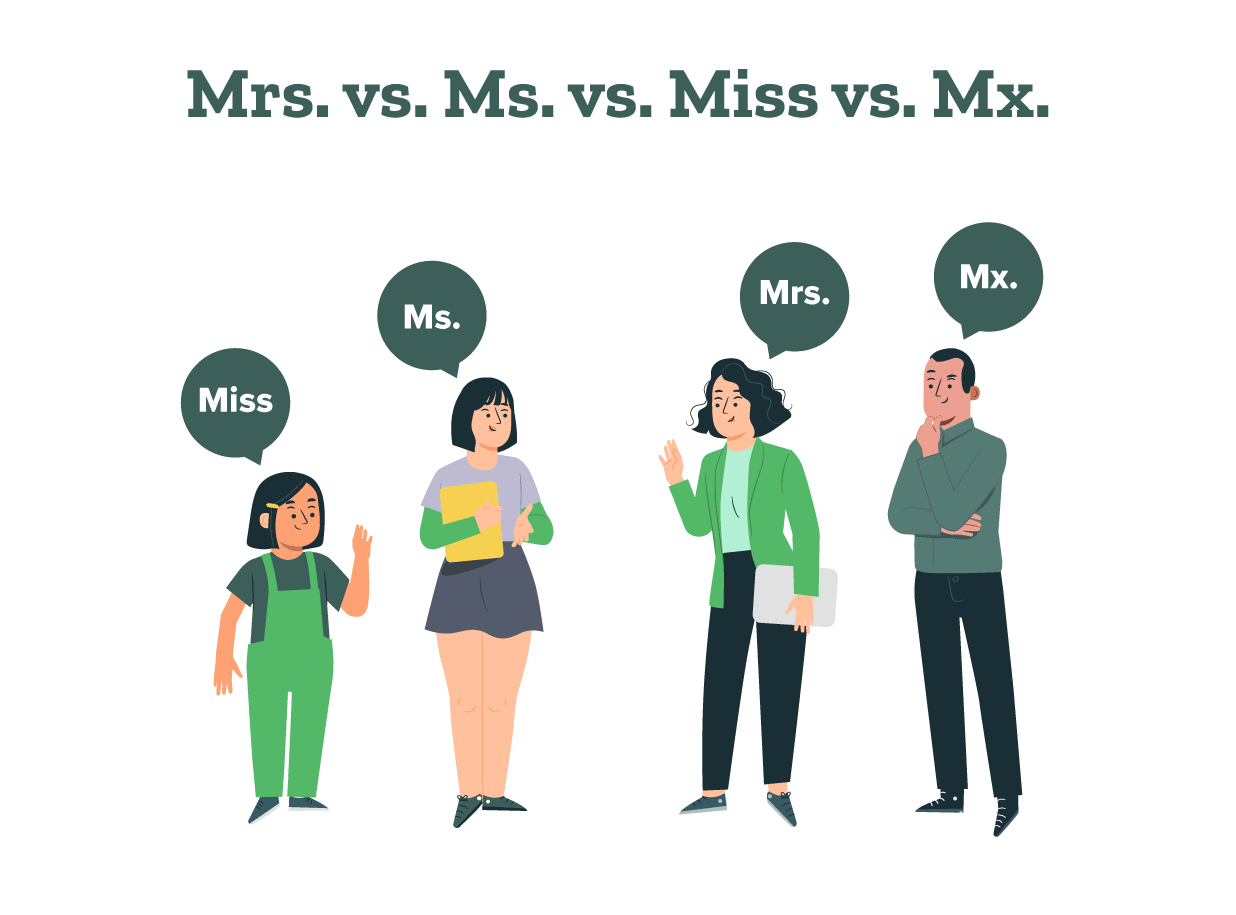
Ms. vs. Mrs. vs. Miss vs. Mx. | Uses and Pronunciations

In a world that values inclusivity, it is important to understand the proper usage of honorifics such as Ms., Miss, Mrs., and Mx. These titles are not merely linguistic conventions but carry social and cultural implications. 

A reason why everyone is confused about Mrs. vs. Ms. vs. Miss, how to use them, and whom to address them, is that they sound and spell quite similar to each other. Let’s delve into the differences, uses, and examples of these courtesy titles in this article. 

Ms. vs. Mrs. vs. Miss vs. Mx.

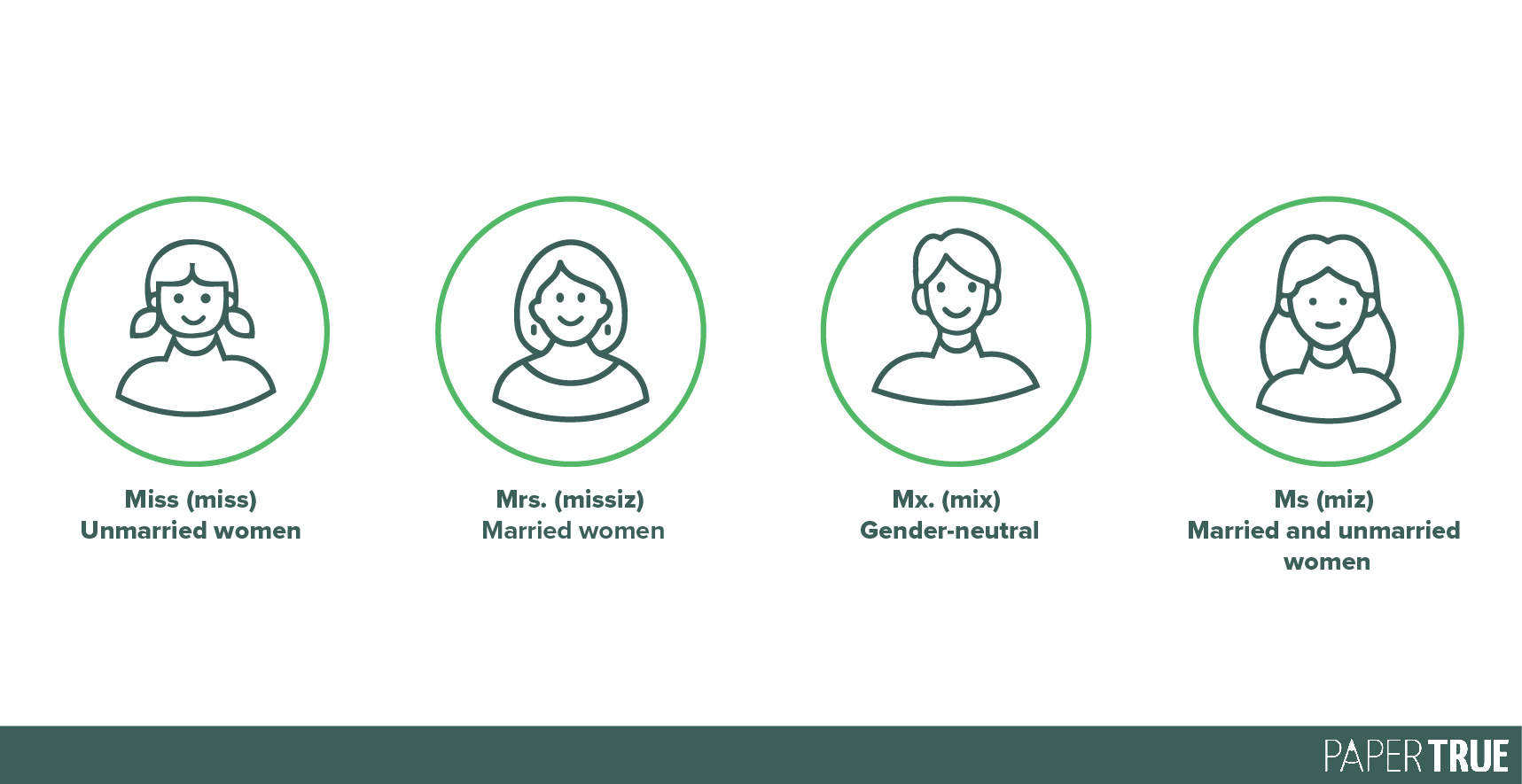
Use Ms. when marital status is unknown or irrelevant, Mrs. for married women (often who took a spouse’s surname), Miss for unmarried or young girls, and Mx. as a gender‑neutral title.

Ms. is a status-neutral title that can be used for women regardless of whether they are married or not. It does not indicate their marital status.

Mrs. is typically used for women who are married. It indicates their marital status. Widows can also choose to be addressed with this courtesy title.

Miss is typically used for girls and women who are not married. It is also used to address young girls who have not crossed the age of 25. 

Mx. is a relatively new and gender-neutral title that acknowledges the spectrum of gender identities beyond the traditional binary of male and female.

The difference between Ms. vs. Mrs vs. Miss vs. Mx. is clearly explained.

Let’s look at the differences between these titles one by one to make it easier for all of us.

Ms. vs. Mrs. vs. Miss

Ms.: A status-neutral option

The honorific Ms. is a title that does not directly indicate the woman’s marital status. In today’s society, Ms. has gained popularity as a way to address women who prefer their marital status not to be taken into consideration. 

Ms. recognizes women for who they are, rather than focusing on their marital status. If one is not sure about the marital status of a woman, using Ms. to address them can be a safe option.

For example,

Ms. Roberts is our new manager.

The book was authored by Ms. Turner.

Ms. Brown is a talented artist whose work is known worldwide.

Ms. Patel organized a party for everyone.

The award was given to Ms. Sanchez.

The lady, Ms. Dutta, was an exceptional singer.

It’s important to note that some women may choose to use Ms. regardless of their marital status to avoid any assumptions about their personal life. 

Mrs.: A title denoting married status

The honorific Mrs. is a title that traditionally indicates a woman is married and has taken her husband’s last name. It represents the marital status of a woman who uses this title. 

For example,

Mrs. Jones celebrated her 3rd wedding anniversary.

Mrs. Davis is a highly respected lady in society.

Mrs. Smith is a well-known author.

Mrs. Taylor has been married for 15 years.

Our teacher, Mrs. Garcia, gave us a surprise test.

Mrs. Anderson and her husband are hosting a party tonight.

It is bound to create confusion about when to use Miss vs. Ms. in our heads. When referring to women, the titles Ms. and Miss. are often used interchangeably. However, there is a subtle difference between the two. 

Bonus Tip: In US English, a period is added at the end of the courtesy titles, Mrs., Ms., and Mx. In UK English, after the courtesy titles, Mrs, Ms, and Mx, a period is not added.

Miss: A title denoting unmarried status

The honorific Miss is a courtesy title traditionally used to address or refer to an unmarried woman or a girl. 

The main difference between the two is that Miss conveys the idea of being unmarried, while Ms. is a more neutral and inclusive term.

For Example,

Excuse me, Miss. You forgot your bag.

Can you ask Miss Dutta to join us for the conference?

Miss Stark is our beloved teacher. 

Excuse me, Miss, do you know where the nearest pharmacy is?

I would like you to meet Miss Daisy, our new math teacher.

Miss Cooper is organizing the charity event.

A woman who is separated from her partner might not wish to be addressed as Mrs. anymore. Similarly, an unmarried woman may prefer not to be referred to as Miss. Using Ms. recognizes women, for who they are, rather than focusing on their marital status.

Grammar errors are easy to miss. We can help!

Mx. | use and examples

Mx. is a relatively new title that acknowledges nonbinary, gender-nonconforming, and transgender individuals. Mx. is becoming more commonly used in official and legal contexts to provide a gender-inclusive alternative to Mr. and Ms. 

The key difference between Mx. and Mrs. vs. Ms. vs. Miss is that Mx. is a gender-neutral courtesy title that can be used instead of a masculine or feminine honorific. While Ms., Miss, and Mrs. are courtesy titles that are used traditionally to address women based on their marital status. 

For Example,

We would like to introduce Mx. Kim.

Mx. Carter and their partner will be hosting a charity event.

Mx. Jones is a dedicated journalist.

Our principal, Mx. John, is an avid reader.

We gave a gift to our neighbor, Mx. Singh.

Mx. Nathan got his driving license. 

Miss vs. Ms. vs. Mrs. vs. Mx. pronunciation

The pronunciation of Miss vs. Ms. vs. Mrs. vs. Mx. can be understood in the following ways:

  • Miss is typically pronounced as “miss” with a short “i” sound

It rhymes with ‘kiss’

  • On the other hand, Ms. is commonly pronounced as “miz” with a short “i” sound as well

It rhymes with ‘is’

  • Mrs is typically pronounced as “missiz”

It rhymes with ‘miss’ and ‘is’ together

  • Mx is typically pronounced as “mix”

It rhymes with ‘six’

Common contexts

  • Ms.: Professional, formal, general
  • Mrs.: Personal, formal, traditional
  • Miss: Polite address for young women/girls; traditional contexts
  • Mx.: Inclusive forms, institutions supporting gender‑neutral titles

To avoid mistakes while using courtesy titles and other grammatical errors, you can take the help of our professional editing and proofreading services.

To understand more about grammar-related topics, keep reading! 

The Best Essay Graders of 2025 That You Can Use for Free!

Dread writing an essay? It’s probably one of the toughest aspects of student life. Students worldwide face the difficult task of gathering their thoughts and penning them down on paper to draft an essay that gets them an A. But won’t it be great if you can find out whether your essay is impressive before your teacher grades it? Essay graders can help you do exactly that! 

We have compiled a list of the best essay graders in this article, including some artificial intelligence (AI) essay graders. If you search “ai essay grader free”, you’ll be swamped with options, but here are the 10 best essay graders you can use for free. 

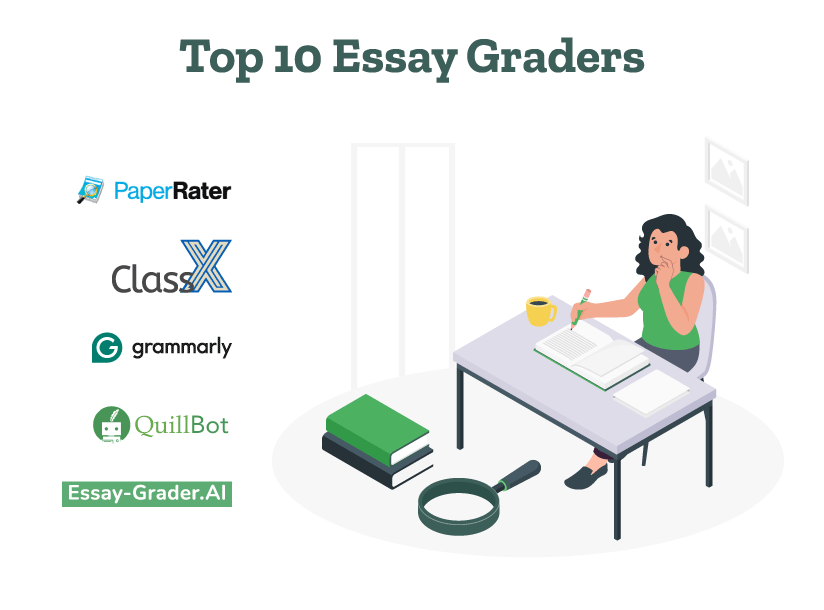
Here are 10 popular essay graders: 

  1. PaperRater
  2. Class X’s AI Essay Grader
  3. Grammarly Free Essay Checker
  4. QuillBot’s Free AI-powered Essay and Paper Checker
  5. Essay-Grader.AI
  6. Perfect Essay Writer.ai
  7. ProWritingAid’s Essay Checker
  8. EduBirdie’s Essay Grader
  9. PlagiarismSearch’s Free Essay Grader
  10. Plagiarism Detector.net

Let us review these free essay graders in detail. 

Explore top-notch essay editing and proofreading services.

Ten popular essay graders of 2024

1. PaperRater

PaperRater is a free online essay grader that helps students improve their writing by checking essays and papers. It corrects grammar mistakes, including spelling and punctuation. It also gives suggestions to improve word choice and style, providing an overall assessment.

To use the essay grader online, paste your text into their online tool or upload a file, select the right options, and click “Get Report”. The tool then analyzes the text and provides a detailed report with feedback. 

Rating: ⭐ 4.6/5

Best For: Quick grammar and style checks

Features:

  • Detects grammar, spelling, and punctuation mistakes
  • Suggests better word choice and style improvements
  • Generates detailed reports with an overall assessment
  • Simple paste-and-check interface

Pricing: Free basic use, Premium at $11.21/month or $71.55/year

2. Class X’s AI Essay Grader

Class X offers a free essay grader where students can paste their essays, stating the class in which they study, along with the essay’s subject line. The tool grades their essay at the click of a button, giving them detailed feedback on the write-up. It also displays the score, showing the “Criteria”, “Score”, and “Explanation” for each element. 

Class X’s premium essay grading services are chargeable but offer extensive services to support the educational endeavors of both students and teachers. With a Premium or Pro membership, you can get rid of advertisements and enjoy multiple benefits, including interactive exercises and media. 

Rating: ⭐ 4.5/5

Best For: Students needing detailed scoring

Features:

  • Grades essays by criteria (clarity, structure, grammar, etc.)
  • Provides scores with explanations
  • Designed for both students and teachers
  • Premium unlocks interactive practice & ad-free use

Pricing: Free basic, Premium $72/year, Pro $152/year

3. Grammarly Free Essay Checker

Grammarly’s free essay checker is a great college essay grader that can help you polish your essay before submitting it for your teacher’s final review. All you need to do is paste the content of your essay and check Grammarly’s suggestions. 

The free version masks some suggestions, which are only available through Grammarly Premium. 

Rating: ⭐ 4.8/5

Best For: Everyday grammar & readability checks

Features:

  • Detects grammar, spelling, and tone issues
  • Suggests conciseness and clarity improvements
  • Plagiarism detection is available in Premium
  • Browser extension & app integration

Pricing: Free basic, Premium $12/month, Business $15/member/month

4. QuillBot’s Free AI-powered Essay and Paper Checker

QuillBot’s free essay checker is a game-changer for students. Apart from the standard grammar, spelling, and punctuation checks, it offers a suite of benefits to elevate your writing, including detailed feedback. 

Using QuillBot is simple! Paste your content in the space provided upon clicking the “Essay Checker” option, and get suggestions for modifications and language corrections. You can accept or ignore the suggested changes. You can even write your essay on the website directly and have it formatted, too. 

Rating: ⭐ 4.7/5

Best For: Students who also need rephrasing tools

Features:

  • AI-powered grammar and punctuation checks
  • Style suggestions and detailed feedback
  • Write directly in the editor with formatting
  • Works with QuillBot’s paraphraser & summarizer

Pricing: Free limited use, Premium $8.33/month (annual plan)

5. Essay-Grader.AI

If you are a teacher struggling to grade essays due to the sheer number of submissions every month, Essay-Grader.AI is your chance to leave the stress behind. Essay-Grader.AI offers a host of services that help teachers perform several key tasks to empower students on their academic journey. 

The platform’s AI-enabled grading tools assist teachers in sharing comprehensive feedback with students. Teachers can focus on student development, offering personalized guidance and instruction through a quality feedback mechanism across various teaching modes.  

While the free version is quite useful and effective, Essay-Grader.AI has Premium and Pro versions.

Rating: ⭐ 4.4/5

Best For: Teachers grading multiple essays

Features:

  • AI grading with personalized feedback reports
  • Supports up to 250 essays/month (Premium)
  • Useful for schools and classrooms
  • Helps track student progress with structured reports

Pricing: Free basic, Pro $7.99/month, Premium $12.99/month

6. Perfect Essay Writer.ai

This online essay grader is perfect for high school, college, master’s, and doctoral students. Once you paste your essay into the textbox provided on the platform and hit “Generate”, it will offer a detailed report on how your essay might fare upon submission. 

For a comprehensive assessment of your essays with detailed input on structure, clarity, and grammar, Perfect Essay Writer.ai is a great tool! 

You can also hire a writer using the “Hire Human Writer” option available on the site. These writers take care of formatting, bibliography, and proofreading, among other things. 

Rating: ⭐ 4.3/5

Best For: Detailed essay structure analysis

Features:

  • Generates reports on grammar, clarity, and structure
  • Suited for high school to doctoral-level essays
  • Option to hire human writers for custom essays
  • Covers formatting, bibliography, and proofreading

Pricing: Free tool, human writers from $11/page (300 words)

7. ProWritingAid’s Essay Checker

ProWritingAid’s free essay grader gives useful suggestions to help you improve your essay. You can accept or reject these suggestions based on your understanding and judgment. This tool can be added to your browser, too, as an extension. So, you get better grades than before and become a better writer with each passing day—what more could anyone ask for? 

If you are looking for unlimited word count usage, style guide input, citations, unlimited storage capacity, and critique, among other services, the website also offers Premium and Premium Pro packages. 

Rating: ⭐ 4.6/5

Best For: Writers needing in-depth feedback

Features:

  • Grammar, style, and readability suggestions
  • Works as a browser extension and a desktop app
  • Customizable style guides and in-depth reports
  • Great for long essays and academic papers

Pricing: Free limited version, Premium $10/month, Premium Pro $12/month

8. EduBirdie’s Essay Grader

EduBirdie is a comprehensive writing platform that offers various services like essay writing, dissertation writing and editing, research paper editing, application essay writing, term paper writing, etc. The site has a very easy-to-use interface, making essay grading a cakewalk. 

Like Perfect Essay Writer.ai, you can hire a human writer. The best part is that you can select one after reading reviews and considering their finished paper numbers. Depending on the writer you select and the writing specifications (word count, essay type, etc.), the platform will charge your account upon placing an order. 

Rating: ⭐ 4.2/5

Best For: Students who may also want writing help

Features:

  • Grades essays for grammar, formatting, and clarity
  • Easy-to-use interface
  • Option to hire human writers/editors
  • Supports essays, research papers, and applications

Pricing: Free grading, human writers from $13.99/page

9. PlagiarismSearch’s Free Essay Grader

This free online essay grader allows you to upload files from Dropbox, OneDrive, or your computer, or you can paste content directly into the textbox for analysis. It can help students at different levels, including high school, college, university, master’s, and doctoral. 

Teachers, universities, and organizations will find these services useful and reasonable as they boost productivity. 

The website rates papers from any discipline and offers round-the-clock support. Qualified writers deliver polished documents to ensure your paper receives the best grade possible. 

Rating: ⭐ 4.3/5

Best For: Students needing plagiarism + grading

Features:

  • Upload from Dropbox, OneDrive, or directly paste
  • Works for high school to doctoral-level essays
  • Generates plagiarism + grammar reports
  • 24/7 support available

Pricing: Free tool, paid paper analysis from $4.50–$9.50+

10. Plagiarism Detector.net

Plagiarism Detector.net does not place a cap on the number of essays that can be graded on its user-friendly platform. This free online essay grader allows you to grade as many essays as you want and assures the confidentiality and security of your essays by not saving them in its database. 

It checks for issues under the following heads: Consistency and Style, Formatting Errors, Repetition, Misused Words, and Unnecessary Capitalization.

While the platform has paid plans for plagiarism detection, the essay checker feature is free for all users. 

Rating: ⭐ 4.1/5

Best For: Unlimited free essay grading

Features:

  • No cap on the number of essays graded
  • Checks consistency, style, formatting, and repetition
  • Ensures essay confidentiality (no saving in database)
  • Paid plans for advanced plagiarism detection

Pricing: Free grading, paid plans from $20/month (72,000 words) 

Why should you use a free essay grader online? 

A Pew Research Center report says that almost 19% of students acquainted with ChatGPT have used it while working on school assignments. So, is it possible to keep AI away from academics? It does not seem so! Besides, AI has been helping students and teachers learn faster and perform better than before. 

AI-assisted teaching and learning might be a good solution, where humans use AI models to improve education. 

Here are some compelling reasons why you should use a free essay grader online:

      • Feedback mechanism: Free essay graders display detailed feedback. 
      • Objective approach: Free online essay graders offer an unbiased evaluation.
      • Writing skills: These tools help improve your writing skills by suggesting corrections.
      • Time management: Online essay graders help you save essay correction time. 
      • Grammar and style: Essay graders enable you to fix grammar and stylistic errors.

Still worried that your essay might not receive a good grade? Check out PaperTrue’s essay editing and proofreading services and get your essay edited by experts. Here are some other articles that might interest you: 

What Is Plagiarism? Meaning, Types & Examples

You may have heard of the term plagiarism, but do you know what it involves? It is crucial to have a clear understanding of what constitutes plagiarism to avoid academic misconduct. In this article, learn everything, from the plagiarism definition to the types of plagiarism. With this, we’ve included useful examples of plagiarism. 

We’ve also answered many questions, such as: How to check for plagiarism? How to avoid plagiarism? So, without further delay, let’s begin! 

Get a thorough plagiarism check and comprehensive editing!

What is plagiarism? 

Plagiarism is the act of presenting someone else’s work or ideas as your own without giving them credit. It is considered a serious offense in academic and professional settings, as it violates ethical standards. The consequences of plagiarism can range from failing a course to legal action, depending on the incident’s severity.

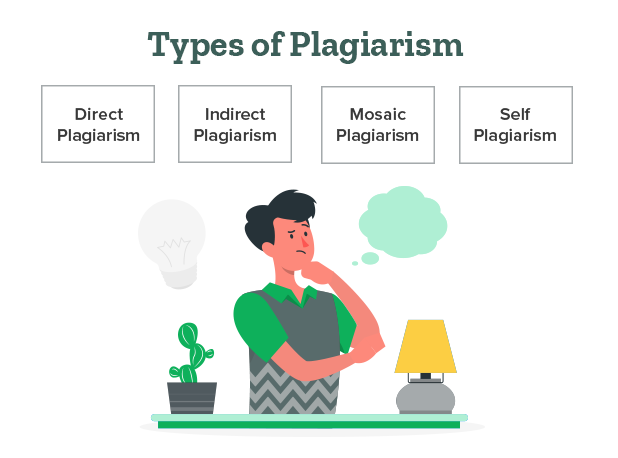
After understanding what plagiarism is,  let’s learn more about the different types of plagiarism. For those wondering about how many types of plagiarism are there, the answer is 7. Explore all types with practical plagiarism examples! 

What are the different types of plagiarism? 

1. Direct plagiarism 

Direct plagiarism involves reusing and copying someone’s exact words without giving them credit. Not including quotation marks for the text copied also indicates direct plagiarism. 

Also, if you’re translating someone else’s work and not acknowledging the original author, it is considered direct plagiarism. 

Let’s see an example of direct plagiarism! 

Plagiarized text: What really knocks me out is a book that, when you’re all done reading it, you wish the author who wrote it was a terrific friend of yours and you could call him up on the phone whenever you felt like it. That doesn’t happen much, though.

The above lines are from J.D. Salinger’s The Catcher in the Rye. However, the fact that they’re used without quotation marks and the author or his work isn’t mentioned indicates direct plagiarism. 

2. Mosaic plagiarism 

Mosaic plagiarism involves taking text, ideas, or concepts from multiple sources and combining them to create a “new” work. Rearranging the sentences from another source and mixing exactly directly copied and paraphrased text is also mosaic plagiarism. Mosaic plagiarism often maintains the general structure of the original source, rearranging phrases while keeping the overall framework and meaning. Additionally, it involves borrowing the author’s language, using phrases or synonyms from the source.

Now, let’s browse through an example of mosaic plagiarism! 

Plagiarized text: Life is a journey filled with choices and aspirations. When you truly desire something, the entire universe aligns itself to assist you in attaining it. At times, we encounter two paths diverging in the forest of life, and the decision to take the less-trodden route can make all the difference.

Original quotes

“And, when you want something, all the universe conspires in helping you to achieve it.” (The Alchemist by Paul Coelho)

“Two roads diverged in a wood, and I— / I took the one less traveled by, / And that has made all the difference.” (The Road Not Taken by Robert Frost) 

3. Self-plagiarism

Self-plagiarism means reusing one’s previous work without giving credit to the original source. This includes: 

  • Publishing the same content in multiple outlets without disclosure. For example, submitting a research article to two different journals simultaneously without informing the editors or publishers.
  • Reusing data or results from a previous study without proper context in a research paper. 
  • Duplicating one’s own published text without quotation marks or citations
  • Reusing portions of one’s own published tables, figures, or images. 

Here is an example of self-plagiarism: 

Suppose a researcher named Dr. John Smith conducted a study on the effects of a new drug on blood pressure and published the results in a journal article titled “The Efficacy of Drug X in Lowering Blood Pressure” in 2018. A year later, Dr. Smith is working on a new paper about the long-term effects of the same drug.

Original text from the 2018 paper:

“The results of this study demonstrate that Drug X significantly reduces systolic and diastolic blood pressure in patients with hypertension. The mean reduction in systolic blood pressure was 15 mmHg (p < 0.001), and the mean reduction in diastolic blood pressure was 10 mmHg (p < 0.001). These findings suggest that Drug X is an effective treatment option for individuals with high blood pressure.”

Self-plagiarized version in the new paper:

“Drug X is effective in reducing blood pressure in patients with hypertension. In a previous study, the mean reduction in systolic blood pressure was 15 mmHg (p < 0.001), and the mean reduction in diastolic blood pressure was 10 mmHg (p < 0.001). These results indicate that Drug X is a viable treatment option for managing high blood pressure.”

4. Accidental Plagiarism 

Accidental plagiarism is when you unintentionally and accidentally copy someone else’s work or ideas without giving them credit. It occurs when you fail to cite sources or properly credit original authors due to negligence or lack of understanding. Unintentional paraphrasing can lead to accidental plagiarism when a person closely mimics the language and structure of a source.

The following are some instances that are considered accidental plagiarism: 

  • Forgetting to include citations for paraphrased or summarized information
  • Improperly paraphrasing or closely mirroring the original source’s language
  • Failing to use quotation marks for direct quotes
  • Reusing one’s own previously published work without self-citation

Following is an example of accidental plagiarism: 

Scenario:

A student named Lina is writing a research paper on the effects of social media on mental health. While writing her paper, she comes across an idea that she believes is her own but is actually a paraphrased version of a sentence she read in one of her sources.

Original text from the source:

“Excessive use of social media has been linked to increased feelings of loneliness, anxiety, and depression, particularly among young adults who spend a significant amount of time on these platforms (Johnson et al., 2019).”

Accidentally plagiarized version in Lina’s paper:

“Studies have shown that spending too much time on social media can lead to increased loneliness, anxiety, and depression, especially in young adults.”

In this example, Lina unintentionally paraphrased the original text without providing a proper citation. Although she may have believed that the idea was her own, the similarity to the original source constitutes accidental plagiarism.

5. Complete plagiarism 

Complete plagiarism means copying someone’s entire work and passing it off as your own. Verbatim plagiarism is the act of copying another author’s text word-for-word without proper attribution. It involves submitting or presenting a full work such as a book, article, research paper, or creative piece, done by others. 

It is considered intellectual property theft and can damage one’s reputation and credibility. 

Let’s see a very brief example of this! 

Plagiarized version:

An old silent pond…

A frog jumps into the pond,

splash! Silence again.

Original haiku by Matsuo Bashō

“An old silent pond…

A frog jumps into the pond,

splash! Silence again.”

6. Source-based plagiarism 

Source-based plagiarism is providing inaccurate and misleading information about the source. Some instances of source-based plagiarism include: 

  • Improperly citing a source and making it difficult to locate the original material. 
  • Citing a secondary source without acknowledging the primary source. 
  • Paraphrasing the source incorrectly by only rearranging the words. 
  • Failing to cite a source while using its unique structure, research methodology, or approach
  • Removing quotation marks while directly quoting a source. 

Browse through the following example to understand better! 

Original text from a source:

“Climate change is a pressing global issue. Rising temperatures, caused by increased greenhouse gas emissions, lead to melting polar ice caps, rising sea levels, and more frequent extreme weather events (Johnson, 2021).”

Plagiarized version:

Climate change is an urgent worldwide problem. Increasing temperatures, resulting from higher greenhouse gas emissions, cause melting polar ice caps, increasing sea levels, and a higher frequency of extreme weather events.

7. Paraphrasing plagiarism 

Paraphrasing plagiarism occurs when a writer rephrases a source’s content without giving credit or significantly alters the original text’s structure and meaning. This type of plagiarism may be unintentional, resulting from poor paraphrasing skills or due to a misunderstanding of citation requirements. Changing a few words or a few phrases from another’s work without proper attribution can still qualify as plagiarism. Using someone else’s ideas or language without proper attribution constitutes plagiarism. It is crucial to credit the original source to avoid any form of plagiarism when utilizing someone else’s words or others’ work.

Following is an example of paraphrasing plagiarism: 

Plagiarized version:

Climate change is an urgent worldwide problem. Increasing temperatures, resulting from higher greenhouse gas emissions, cause melting polar ice caps, increasing sea levels, and a higher frequency of extreme weather events.

Original text from a source:

“Climate change is a pressing global issue. Rising temperatures, caused by increased greenhouse gas emissions, lead to melting polar ice caps, rising sea levels, and more frequent extreme weather events (Johnson, 2021).”

In this example, although some words have been changed (e.g., “pressing” to “urgent,” “global” to “worldwide”), the overall content and ideas are very similar to the original text. 

After understanding the common types of plagiarism, let us see the repercussions of plagiarizing sources 

The damaging effects of plagiarism 

The following are the major consequences of copying sources without giving the original author credit: 

  1. Academic penalties: These include failing grades on assignments/courses, academic probation, suspension, and revoking degrees or academic credentials. 
  2. Legal repercussions: Depending on the seriousness, effects can be copyright infringement lawsuits, monetary fines, and settlements. 
  3. Professional impact: The consequences can be termination of employment, ineligibility for grants, funding, professional membership, and blacklisting within the industry or professional community. 

Now, let’s understand how to check the text for plagiarism. 

How to check for plagiarism? 

While facts considered common knowledge do not require citation, it is important to err on the side of caution and cite anything that may not be universally recognized within a specific field. The following are some methods that you can use to check plagiarism for your document:

1. Use plagiarism checkers

You can use free plagiarism checkers like Duplichecker, Search Engine Reports, Copyleaks, and Small SEO tools. These tools will analyze your text and provide a percentage of plagiarized content. 

2. Conduct a thorough internet search 

To do this, copy and paste key phrases and sections from your text on the Internet. Observe if there are similarities with existing online content like websites, articles, or published materials. 

3. Compare your work with authoritative sources 

Analyze credible and authoritative sources related to your topic, such as academic journals, books, or reputable websites. Look for similarities in language, sentence structure, or ideas that may indicate plagiarism.

4. Ask for feedback 

You can ask your colleagues or other experts in the same field to review your work for plagiarism. Fresh eyes can catch any similarities that you may have missed. 

5. Use text-matching tools/document-comparison software 

These tools detect plagiarism by analyzing and comparing two or more documents. You can use tools like WCopyfind, DocFetcher, Copyleaks, and GoTranscript to check your document for plagiarism. 

These tools can also be useful for identifying instances of self-plagiarism or accidental reuse of your previous work.

Now, let us understand how to ensure the text doesn’t contain plagiarized content. 

How to avoid plagiarism? 

It is crucial to understand ‘unintentional plagiarism’ and distinguish it from intentional plagiarism. To avoid plagiarism, practice thorough citation and use plagiarism detection tools. The following are the ways:

1. Cite all sources accurately

Understand all the citation style guidelines for your field or profession (APA, MLA, Chicago, etc). Include all sources in the reference page and include in-text citations for the sources. 

Bonus Tip: You can also use citation generators like Citation Machine and Zotero to accurately cite sources. 

 2. Paraphrase and summarize

Instead of copy-pasting the exact sentences, write the sentences in your own words and capture their meaning. Use synonyms and change the sentence structure and voice. You can also break down the text into small points or ideas to paraphrase the text. You can use AI paraphrasing tools like QuillBot, Paraphrase.io, and WordAI to paraphrase your work. 

If you’re still unsure about how to avoid plagiarism, you can consult experts in your field and other colleagues. Alternatively, you can opt for professional help if needed. Searching for ‘write my essay for me no plagiarism’ can connect you with services that guarantee original, plagiarism-free essays tailored to your requirements.

Now that you know the plagiarism types and how to check for plagiarism, you can avoid plagiarism. You can bookmark this article to revisit the types and examples of plagiarism. 

Once you remove any instances of plagiarism, the next step is to edit your work. As trusted experts in editing and proofreading services, we’d love to elevate your text! 

Here are some other useful resources for you: 

Audiobook Marketing Guide: Best Strategies, Tools & Ideas

You’ve created an amazing audiobook, but how to get more listeners to sit up and take notice? This guide includes the best tools and 14 strategies to help you achieve this goal. From creating social media posts to using paid advertising, this guide includes all you need to know. 

Plus, we’ve added 10 creative marketing ideas to help your audiobook reach maximum listeners. So let’s discover the secrets to successful audiobook marketing!

Create And Market Your Audiobook To Boost Sales Now! Get Started

Why is audiobook marketing important? 

Marketing helps your audiobook stand out in a market saturated with many options. By using the right marketing methods, you can ensure that your audiobook gets the attention it deserves. 

Some other benefits of marketing are: 

  • Sell more copies: The more people know about your audiobook, the more likely they are to buy it.
  • Build your reputation: Marketing helps you become a well-known author or narrator.
  • Encourage word-of-mouth: When people like your audiobook, the chances of them telling their family and friends about it are higher.
  • Get helpful feedback: Reviews and comments for your audiobook can help you understand what your audience likes and dislikes.

When it comes to understanding audiomarketing basics, understanding your target audience is crucial. This includes the age, gender, location, interests, hobbies, etc., of your listeners. Once you analyze your target audience, you can explore the best audiobook marketing services given below. 

How to market an audiobook (Best strategies made easy!) 

The simplest strategy is to take advantage of the marketing options provided by audiobook distribution services. Many audiobook distribution platforms (e.g., Audible, Kobo Writing Life, Google Play Books, etc.) offer various promotional tools, including pre-orders, discounts, and promo codes for marketing. 

Marketing an audiobook

Some other advanced audiobook marketing strategies are: 

1. Reach out to audiobook bloggers and reviewers and provide them with a copy of your audiobook in exchange for an honest review. 

2. Create an email marketing campaign to promote your audiobook. Build a mailing list of interested subscribers and send regular updates, exclusive content, and promotional offers.

3. Building listener loyalty with bonus content makes your listeners eagerly anticipate your audiobook releases. You can offer exclusive bonus content, including extra chapters, deleted scenes, author comments, etc. Bonus content can also include a downloadable PDF (e.g., a reader’s guide) or access to an exclusive interview with the author. 

4. Offer bulk discounts or promotional codes to organizations or groups that align with your audiobook’s topic. This could include schools, book clubs, or professional associations. 

5. To enhance digital and community engagement, share engaging photos and videos about your audiobook. You can also engage listeners with behind-the-scenes content related to your audiobook. This can include interviews with the author, narrator, or the production team, or it could involve sharing videos of the recording process for engagement. A good practice is to share this content on various platforms like Facebook, Instagram, X, etc. 

6. Partner with podcasters and YouTubers who specialize in audiobook reviews, recommendations, or discussions. You can offer them free copies of your audiobook in exchange for an honest review or feature on their show. 

7. One of the best marketing strategies is hosting exclusive audiobook giveaways and promotions for audiobook lovers. This can include free audiobook downloads, signed copies of the physical book, or even a chance to have a character named after the winner in your next audiobook. You can give more information about giveaways and promotions on social media platforms. 

8. Create a unique author brand voice by sharing personal stories, incidents, and what you think about your audiobook’s content. You can also use specific colors, fonts, and images to create your unique brand voice. 

9. Host contests on social media to create excitement about your audiobook. You can offer prizes such as a gift card to an online bookstore, a signed copy of a related book (if you have one), or even a piece of merchandise (e.g., T-shirts) related to your book’s theme. 

10. Try audiobook advertising on platforms like Facebook, Amazon KDP, Audible, or Goodreads and target listeners who are interested in your audiobook’s topic. When advertising on Amazon, target readers who have shown interest in Amazon audiobooks similar to yours.

11. Search Facebook for groups related to your audiobook’s genre (e.g., “mystery audiobook lovers,” “fantasy audiobook fans,” “romance audiobook readers”). Join groups related to your audiobook’s subject to promote your audiobook. By leveraging these genre-specific marketing tactics, you can build a loyal fan base for your audiobook. 

12. Attend audiobook-related events, conferences, and festivals to network with industry professionals and potential listeners. 

13. Use Book Brush, an online tool, to create stunning audiobook graphics and promotional images. Book Brush offers a user-friendly interface and a wide selection of templates specifically designed for books and audiobooks. 

14. Create QR codes that link directly to your audiobook’s purchase or sample page. Encourage people to scan the code for easy access to your audiobook. 

10 creative audiobook marketing ideas 

To market your audiobook as one of the best audiobooks in your genre, consider participating in offline events. This includes panels and workshops about your audiobook’s topic. The following are some other creative audiobook marketing ideas:

1. Organize a live book tour where you can read a few excerpts from your audiobook. You can read selected passages from your audiobook, giving the audience a taste of how the story sounds when narrated. By using your voice, you can bring the characters to life with different tones, inflections, and pacing to convey the characters’ emotions. 

2. Create interactive audiobook snippets for social media platforms. These are short audio clips featuring an excerpt of your audiobook. 

3. Create a website or landing page dedicated to your audiobook. Include a description, sample chapters, narrator information, and purchase links.

4. Collaborate with other authors or narrators in your genre. Cross-promote each other’s audiobooks to reach new audiences. 

5. Use Chirp to promote your audiobook. Chirp is an audiobook promotion platform that offers limited-time deals to subscribers. 

6. Utilize Bookfunnel for audiobook distribution and promotion. Bookfunnel offers features like landing pages and email integrations to help with marketing.

7. Use AudioFile Magazine for promotion. AudioFile Magazine is a well-respected publication in the audiobook industry. Submit your audiobook for review consideration. If your audiobook is reviewed positively, share the review on your marketing channels. Consider advertising in AudioFile Magazine to reach a larger audience.

8. Hosting virtual listening parties is an engaging way to connect with your audience. Invite your audience to join you for live virtual listening parties. During these events, you can organize “Author Q&As” where you discuss your audiobook, answer questions from listeners, and offer exclusive discounts. To maximize attendance and participation, promote these virtual listening parties on your website and social media channels.

9. Use LibraryThing to connect with librarians, readers, and reviewers. LibraryThing is a platform where book lovers discuss their favorite books. Engage with the community, offer your audiobook for review, and participate in relevant groups to promote your audiobook.

10. Use Whispersync for Voice to sync your audiobook with the Kindle eBook version. This feature allows readers to seamlessly switch between reading and listening, enhancing the overall user experience. You can promote this feature to attract more readers who enjoy both audiobooks and eBook formats. 

To conclude, marketing your audiobook is crucial to reach the maximum number of readers. At PaperTrue, we can help you market your audiobook. We can create a teaser and promotional post for your audiobook. Plus, we can also help distribute your audiobooks on popular platforms, including Google Play, Apple Books, and Kobo Writing Life. 

We also provide additional self-publishing services like creating a promotional video, blurb, copyright page, and book cover design for books. Curious to know more? Connect with us for more information about our services! 

According to you, which marketing strategy is the best for audiobooks? Share your thoughts in the comments section! 

Here are some useful resources for you: 

Top 10 Essay Editing Services of 2025

If you’re unsure about your writing skills for academic work, college essay editing services can be a lifesaver. But which online essay editing service should you go for? To help you choose the best editor, we’ve made a list of the top ten essay editing services in 2025.

If you want to score well on your essay, you need to present your ideas systematically. So, proper language and formatting are a must in any college essay. You can ensure this by hiring a college essay editing service since an essay editor is trained to spot mistakes you might miss. They also suggest improvements that further improve your essay and help raise your grades.

In this guide, we list the 10 best essay editing services in 2025—with features, pricing, and ratings—so you can easily choose the right one.

Get expert essay editing services from the industry’s top editors.

What is an essay editing service?

An essay editing service is professional support that helps students, academics, and writers refine and improve their written work. These services typically offer a range of options to enhance the quality of essays, research papers, dissertations, and other academic documents.

Benefits of essay editing services

  • Correct grammar, spelling, and punctuation
  • Improve clarity, readability, and tone
  • Ensure logical flow of ideas
  • Adjust style to academic standards
  • Provide feedback to strengthen arguments
  • Check formatting and references

By hiring an essay editing service, you can improve the overall quality of your work, which offers several advantages, like better grades, increased chances of publication, and enhanced overall communication.

The best proofreading and editing services particularly benefit non-native English speakers, students struggling with writing skills, or anyone looking to comply with professional standards. It is important to note that while these services can significantly improve your writing, they do not write the essay for you. The best essay editing services maintain academic integrity by focusing on enhancing your own work rather than creating content for you.

Top 10 essay editing services in 2025

Writing an impactful essay is a piece of cake when professional essay editing services are available. If you could have your essay reviewed before submission, you would no doubt consider getting it done. So, here’s our list of the top 10 essay editing services in 2025.

1. PaperTrue

PaperTrue hires essay editors who are trained in the specific subject to edit essays.  Our editors check your college essay for grammar, word choice, spelling, and punctuation. Along with this, they also leave suggestions for stylistic improvements and help you ensure coherence throughout the essay.

Their services also include checking for plagiarism, cross-checking citations, and ensuring proper formatting. With timely delivery, PaperTrue also provides 24/7 customer support for students with urgent needs. If you need any further checks on your edited essay, you can also get a free revision. 

Features:

  • Subject-specialist editors for academic essays
  • Grammar, punctuation, word choice, and formatting checks
  • Plagiarism check & citation review
  • Free revision included
  • 24/7 support with fast delivery

Pricing: A 1000-word essay costs around $8 with our Essential package.

Rating: ⭐ 4.8/5

2. Scribbr 

Scribbr provides a comprehensive review of your essay. Their editors enhance the essay structure and ensure clarity to improve readability. They also provide feedback about whether to add content and how to reduce the essay length to meet the word count. 

Scribbr also has a tool called Essay Checker, which rectifies any errors with accuracy and speed. With various other tools such as a Plagiarism checker, Citation Generator, and an AI Proofreader, Scribbr ensures high-quality essays. 

Features:

  • Improves essay structure & readability
  • Tools: Essay Checker, Plagiarism Checker, Citation Generator
  • Detailed feedback on content addition/reduction
  • Same-day delivery available

Pricing: Their college essay editing package starts at $0.07 per word for same-day delivery.

Rating: ⭐ 4.7/5

3. Editage

Editage is a specialized editing and essay proofreading service that caters to college students and researchers. They provide editorial assistance for dissertations, papers, and essays.

Editage is more geared towards research publications and helping people get published. So, even if college essays aren’t a direct target for the site, it does offer the service.

Features:

  • Specialized in academic/research editing
  • Advanced, substantive & copy editing packages
  • Helps prepare essays for journals & conferences
  • Subject-area experts across disciplines

Pricing: The price starts from $0.06 per word under the “Advanced” editing package. However, the charges increase when you need same-day delivery.

Rating: ⭐ 4.6/5

4. Kibin

Kibin’s website calls the platform “your essay help hero.” They provide support to students from the brainstorming stage to the polished draft of the essay. Their website has four sections:

      1. Essay examples
      2. Essay editing
      3. Paper grader
      4. Thesis builder

Besides the standard checks for grammar and punctuation, Kibin also provides a review of your idea presentation and sentence structure. If you’re someone who needs help with brainstorming, this is the site for you!

Features:

  • Tools: Essay examples, Paper grader, Thesis builder
  • Checks grammar, punctuation, and sentence structure
  • Helps refine essay ideas and flow
  • Ideal for students starting from scratch

Pricing: A 1000-word essay returned within 72 hours will cost you around $37.50.

Rating: ⭐ 4.5/5

5. EssayEdge

EssayEdge has had a long presence in the industry. Their editors work on various academic documents, essays being one of them. When you place an order, they will pair you with one of their essay editors.

EssayEdge helps you with brainstorming, proofreading, and editing. They help make your writing concise, persuasive, and original. 

They famously claim to hire only native editors who graduated from Ivy League colleges. If you’re someone who cares about this, the platform might just be for you!

Features:

  • Native editors from top universities
  • Brainstorming, proofreading & editing services
  • Focus on making essays concise & persuasive
  • Specializes in admissions essays as well

Pricing: Their “Proofreading” package starts at $69.

Rating: ⭐ 4.4/5

6. Scribendi

Like EssayEdge, Scribendi also profiles its customers into six categories. For students, Scribendi offers a fast turnaround time.  They have the option to order last-minute essays, which can certainly be attractive to some students! They have four additional sections under the student category:

      1. Proofreading
      2. Essay editing
      3. Admission essay editing
      4. Admission essay 

They check your writing for spelling and grammar. Their essay proofreading services include checking the document for minor errors. Aside from this, they also leave comments on the style, clarity, and flow of your admission essay.

Features:

  • Proofreading, essay editing, and admission essay services
  • Corrects grammar, spelling, and clarity
  • Options for last-minute submissions
  • Offers detailed comments on style & flow

Pricing: If you have a week in hand, you can have your 1000-word essay edited for $20.

Rating: ⭐ 4.3/5

7. Enago

Enago is primarily a publication support platform that also offers editing help. They enhance documents belonging to various subject areas like arts, medicine, physical sciences, economics, and business. 

The platform offers three levels of editing: top-impact scientific editing, substantive editing, and copy editing. While these services are better suited to a researcher than a college student, they get the job done.  It means they can help you eliminate errors and ensure clarity.

Enago is one of the top ten essay editing services because it offers clear checkpoints for its editing services. The downside to this is that not all of these checkpoints are included in all their plans. It can be a headache for a student to go through the details of complicated plans and finally select one.

Features:

  • Three levels: Scientific, Substantive, Copy Editing
  • Subject-area experts in medicine, business, and sciences
  • Clear checkpoints for editing services
  • Geared towards researchers and academics

Pricing: A copyedited document of 1000 words returned within 6 days costs $70.

Rating: ⭐ 4.3/5

8. Edubirdie 

Founded in 2015, Edubirdie offers expert essay editing services starting at $7 a page. Every college essay editor is a native speaker from the US or Canada with vast expertise in English. They rectify all grammar and punctuation errors, along with eliminating any typos and word choice mistakes. 

With this, they also correct any formatting errors in the essay. Edubirdie also has various tools, like a plagiarism checker and a citation generator, to help students and researchers. They not only help students to edit essays but also write essays for students. 

Features:

  • Native US/Canada editors
  • Grammar, punctuation, and formatting corrections
  • Extra tools: Plagiarism checker, Citation generator
  • Also offers essay writing services (not recommended for academic integrity)

Pricing: Their prices start at $13.99/page.

Rating: ⭐ 4.2/5

9. Proofed 

Proofed has a dedicated team of over 700 editors. They offer editing, proofreading, and formatting services for students, authors, researchers, and businesses. Their services include editing research papers, manuscripts, journal articles, theses, books, and reports. 

They accept documents in more than 15 formats, which include LaTeX and MS Word. It’s one of the best essay proofreading services for customers who want edited documents within tight deadlines. Proofed can deliver documents of 8000 words or fewer within 24 hours. 

Features:

  • 700+ editors specializing in academic & business texts
  • Accepts LaTeX, Word, and 15+ file formats
  • Delivers essays under 8000 words in 24 hours
  • Offers proofreading, editing, and formatting

Pricing: Their pay-as-you-go model starts from $30 for 1000 words.

Rating: ⭐ 4.2/5

10. Wordvice

Wordvice is an online editing service focused on academic editing. Out of its four categories, three pertain to education, while the fourth one is business editing. Aside from business editing, it offers:

      1. Academic editing
      2. College admissions essay editing
      3. Writer editing services 

The essay editors at Wordvice check your document for grammar, punctuation, and mechanics. They also ensure consistency, vocabulary, and flow in your writing. Apart from this, they improve your writing by adding margin comments that explain the revisions made to your essay.

Features:

  • Focused on academic, admissions, and business editing
  • Corrects grammar, vocabulary, and mechanics
  • Margin comments explaining revisions
  • Improves flow, consistency, and tone

Pricing: A 1000-word document delivered within 168 hours will cost you $23.

Rating: ⭐ 4.1/5

Key Takeaways

  • Best overall & affordable option: PaperTrue
  • Best for research/journal essays: Editage, Enago
  • Best for admissions essays: EssayEdge, Scribendi
  • Fastest delivery: Proofed, Scribbr
  • Best for brainstorming & idea development: Kibin

Working with an essay editing service

A few things to remember while working with an online essay editing service:

      1. Essay review services do just that: they review an essay that you have written. They don’t add any content of their own to the document. Don’t expect these services to write your essay for you!
      2. State your requirements clearly while placing your order. If you state your editing needs upfront, most editing services will be more than willing to accommodate them!
      3. Don’t wait until the last minute to send your essay for editing and proofreading. If there is some miscommunication and you receive an edit you’re unhappy with, you’ll need time to get a revision! Always prepare in advance and leave enough time before the deadline.

Why should you use an essay editing service?

Writing an essay is hard enough, let alone editing it. You may have spent hours (or maybe days) thinking and researching to make sure your ideas come together well. But even after all that effort, it is easy to overlook small mistakes or areas where your writing could be clearer. These are the exact problems an essay editing service can solve. 

Catching grammar mistakes you missed or helping you fine-tune your arguments is an easy job for the best essay editing services in 2024. All the benefits that we have highlighted above in this article tell you how an essay editing service can make a difference. So, it is no wonder that a fresh set of professional eyes on your work can transform your essay into a meaningful and engaging narrative.

We hope these best essay editing services help you choose the most appropriate service for your essay. As experts in essay editing services, we’d love to help you enhance your essay for better grades. We also offer personal statement editing services. Here are some other articles you might find interesting: 

What Is a Thesis: How to Write a Thesis with Examples

You will likely be required to write many compelling theses in your college years. A thesis is an essential part of your academic endeavors in your college years. It enables you to present your thoughts, opinions, and arguments and helps you get the grades you want. But what exactly is a thesis, and how do you write one effectively?

We will answer these questions in this article. Read on and let us know in the comments below if this guide will prove useful when you write your college thesis this academic year. 

Get your thesis edited by experts. Explore our services. Learn more

What is a thesis?

A thesis is a comprehensive statement that presents the main argument or claim of an academic paper, research project, or dissertation. It typically defines the purpose of the work, where readers learn about the researcher or writer’s reasoning. 

Research writers present their logic, explain their point of view based on evidence, and draw relevant conclusions accordingly. In academic writing, a thesis is essential because it provides a clear direction and focus for the entire document.

Types of thesis

There are various types of theses depending on the academic discipline or level of study. In undergraduate and graduate programs, you may encounter analytical, expository, and argumentative theses, each serving different purposes. 

For advanced research projects, doctoral and master’s theses are commonly required. They focus on original research and contribute new knowledge to the field.

  • Argumentative Thesis

This type of thesis takes a stand on a controversial issue and presents an argument that you will need to defend throughout your essay. For example:

“Government surveillance programs are necessary for national security, but they must be balanced with individual privacy rights.”

  • Analytical Thesis

An analytical thesis breaks down an idea or issue into its components, evaluating and analyzing each part. For example:

“The portrayal of women in 20th-century literature reflects the changing roles of women in society.”

  • Explanatory (Expository) Thesis

This type of thesis simply explains a topic to the reader. It does not take a stand or argue a point. For example:

“The process of photosynthesis is essential for plant life and involves several stages, including light absorption and the production of oxygen.”

How to write a thesis

Writing a thesis is a critical skill for any academic or research-oriented work. It involves distilling the essence of your research or argument into a single, clear statement that will guide the rest of your work. 

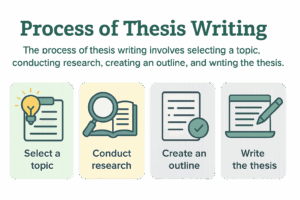
Thesis writing process

Here are the essential steps to writing an effective thesis:

1. Understand your topic

Before you can create a good thesis statement, you need to understand your topic well. So, when a topic is assigned, make sure you understand the requirements. 

If you are asked to choose a topic, choose one that interests you and is broad enough to allow for extensive research but focused enough to enable a clear evaluation. 

2. Craft a preliminary thesis

Once you have a topic in mind, draft a preliminary thesis. Start with a working statement that outlines your perspective, opinion, or argument. This initial thesis does not need to be perfect—it is only a starting point.

Tips for writing a preliminary thesis:

  • Make a claim that can be debated. For example, instead of stating a fact, express an opinion that can be argued.
  • Keep it concise but informative—aim for clarity without over-explaining.
  • Be open to revising your thesis and incorporating or deleting ideas as you continue researching and writing.

3. Make your thesis specific

A strong thesis must be clear, specific, and arguable. It is not enough to simply state your opinion; you need to back it up with a well-reasoned argument that is relevant and specific to your essay topic or the title of your academic paper.

How to refine your thesis:

  • Focus on a specific aspect. Define the scope to cover only relevant points.
  • Be clear and concise. Avoid vague language that confuses the readers or bores them.
  • Ensure all your points are arguable. A good thesis statement should not be a statement of fact. It should present a position that requires evidence and reasoning to support it.

What is a thesis statement?

Developing a relevant thesis statement is essential to writing a good thesis. Let us study the meaning of a thesis statement in this section. 

A thesis statement is a summary of the main point or claim of your essay or research paper. Typically, it appears at the end of the introduction and consists of one or two sentences. Its purpose is to inform the reader of the paper’s central argument. 

A thesis statement, when written well, sets the stage for the discussion that follows in the essay or academic paper. If you are unsure about how to begin, understanding how to write a thesis statement is a critical first step. So, let’s see how to do that.

Thesis statement examples

Understanding the difference between a weak and a strong thesis is essential for developing your own. Before we study some examples, let us understand what makes a strong thesis. 

A strong thesis is clear and specific and presents an arguable and assertive claim. It does not merely state a fact but expresses a position that requires evidence and analysis. It also outlines the key points that will be discussed in the essay or paper. A weak thesis, on the other hand, is vague, unnecessarily comprehensive, or lacks viable arguments. It takes a reader’s focus away. 

Here are some thesis examples:

  • Weak thesis:

“Social media is a popular way to communicate.”

Why it is weak: It is a fact, not an argument.

  • Strong thesis:

“Social media has transformed modern communication, creating both opportunities for global connections and challenges related to privacy.”

Why it is strong: It presents a specific point of view that can be supported with evidence and invites debate.

Popular AI tools like ChatGPT or thesis-specific generators are great for getting started. However, tailor the output to fit the specifics of your assignment to ensure your paper gets a good grade. You can find a list of 2025’s popular thesis statement generators here

Why is writing a thesis important?

Writing a thesis is a key aspect of academic development in your college years. As a student, it encourages you to engage in deep, critical thinking. Crafting a thesis requires you to analyze complex topics, formulate well-reasoned arguments, and present evidence-backed conclusions convincingly. Hence, it strengthens your research and analytical skills. Also, your ability to communicate ideas clearly and persuasively improves. 

A well-written thesis demonstrates mastery over the subject matter and contributes new insights or solutions to a field of study. Additionally, it serves as a benchmark for academic success, showcasing your ability to conduct independent research and engage with scholarly discourse. 

Most important of all, writing a thesis is an essential academic milestone that prompts intellectual growth and contributes to the body of knowledge in a given field.

Thesis writing tips and examples

To write a good thesis, you need a strong thesis statement. A good thesis statement makes for effective academic writing. Here are some concise tips to guide you:

1. Start with a question: Identify a research question to focus your thesis.

Example:

Question: How does remote work affect productivity in the tech industry?

Thesis: Remote work has improved productivity by allowing flexible hours, reducing commute times, and increasing job satisfaction.

2. Keep it specific: Ensure your thesis is narrow enough to explore thoroughly.

Example:

Focused thesis: Climate change is leading to more frequent flooding in coastal areas, threatening environments and human settlements.

3. Make it arguable: Present a claim that invites discussion and requires evidence.

Example:

Arguable thesis: Excessive use of social media among students leads to decreased academic performance due to distractions.

4. Revise as needed: Continuously refine your thesis to align with your evolving research and insights.

5. Support with evidence: Back your thesis with reliable data and examples throughout your paper.

By applying these tips, you’ll create a clear and compelling thesis that provides a solid foundation for your academic work.

AI thesis generators: Can they help? 

AI thesis generators have gained popularity as tools that assist students and researchers in formulating thesis statements quickly. These tools work by analyzing the topic, keywords, and prompts provided, generating potential thesis statements based on patterns and language models. 

While AI thesis generators can offer useful starting points, they are not foolproof. They help streamline the brainstorming process by suggesting concise and coherent ideas, but users should critically evaluate the generated thesis. 

The thesis may need refining to ensure specificity, relevance, and arguability. Overall, AI thesis generators can be helpful for inspiration but should not replace thoughtful analysis and critical thinking in academic writing.

Writing an effective thesis will get you the grades you desire. A strong thesis keeps your essay on track and boosts its engagement quotient. Use this guide to write analytical, argumentative, or explanatory papers and master the art of crafting a solid thesis. With practice, you will be able to create compelling, well-structured theses.

If you need a professional review, get in touch with PaperTrue. Our editors can edit your thesis statements and make sure your essays and academic papers convey the right message and get you top grades every academic year. 

Here are some articles you might want to check out: 

10 Best AI Detector Tools in 2025

If you’re looking for the best AI detectors, your search ends here! Discover all features, pros, cons, and pricing of the top AI detectors. This article will cover various AI writing detectors to help you make an informed decision. 

We’ve also included open AI checkers that provide additional services like humanizing the content. Assistive tools, such as AI writing software, have significantly influenced the content creation process, and our analysis will help you understand their impact. Whether you’re a student, writer, or business professional, this list will help. So, without wasting time, let’s begin! 

AI detection done? Edit and proofread your text today!

1. GptZero 

GptZero is a fast and effective AI content detector. It functions as a ChatGPT AI checker and can also identify AI content from Bard and LlaMa. 

GPTZero-AI-Detector-tool

Pros

  • It allows you to scan up to 5,000 characters at a time for AI-generated content. 
  • Its Deep Scan feature gives a statistical analysis of how every sentence has AI probability. 
  • Its free version allows you to scan 10, 000 words per month. 
  • You can upload 10 files at a time for scanning documents.
  • Additionally, GptZero can assist in the editing process by providing feedback on sections, helping users refine their content. 

Cons 

  • It doesn’t include additional options for humanizing and paraphrasing the content like other tools. 
  • The premium version doesn’t give the option to scan more than 10 files like other tools. 
  • The ‘Writing Feedback’ option is only included in the Premium version and not the free version. 
  • If there is a mix of human and AI content, it is unable to accurately identify how much content is AI-generated. 

Price: It offers 3 Packages for its AI detection service: Essential ($10 per month), Premium ($16 per month), and Professional ($23 per month). 

2. ContentDetector.AI

ContentDetector.AI is one of the top AI content checkers. Featured on Product Hunt, it’s a free AI detector. 

ContentDetector.ai-AI-detector-tool

Pros 

  • It functions as a ChatGPT AI detector (it can identify Gpt 3.5 and GpT 4 content). 
  • It gives a probability score showing the percentage of AI-generated content. 
  • It gives an option to humanize AI sentences. 
  • It provides statistics such as the word count and the character count. 

Cons 

  • It isn’t 100% accurate and sometimes fails to achieve complete accuracy, wrongly identifying human content as AI-written content. 
  • It doesn’t provide additional features to upload and scan files in bulk. It can, however, flag AI-generated content to help users identify it.
  • It doesn’t provide an extension to use it while editing docs on Word or Google Docs. 
  • Unlike other tools, to export the file, you need to sign in and create an account. 

Price: This is a free AI checker tool. 

Now let’s understand how to detect AI writing using ZeroGPT.

3. ZeroGpt 

ZeroGPT is a reliable AI checker. It’s a free tool where you just need to paste the text. ZeroGpt aims to minimize false accusations of human-written content being flagged as AI-generated.

ZeroGPT-AI-detector-tool

Pros

  • It gives a percentage of the AI content detected. 
  • It is more accurate as compared to free AI checkers like Writer. 
  • It functions as a ChatGPT checker and can detect AI content from ChatGPT. 
  • It checks AI content for 15,000 characters at a time. 

Cons 

  • It fails to identify some AI text accurately.
  • The free version doesn’t allow uploading more than 5 files at a time for an AI content check. 
  • The yearly plan is more costly as compared to other tools. 
  • The free version includes the option to paraphrase only 300 words at a time using an AI Paraphraser. 

Price: It has both a free and a paid version. The monthly package starts from $7.99 per month and the yearly package costs $18.99 per month. 

4. Copyleaks 

Copyleaks is one of the most popular plagiarism and AI checker tools. It can detect AI content in multiple languages in seconds. 

Copyleaks-AI-detector-tool

Pros

  • It detects AI content from various AI tools including ChatGPT and Gemini Plus, and can even differentiate AI refined content.
  • It allows you to scan multiple files simultaneously. 
  • It creates a similarity report which you can share (if required). 
  • You can easily integrate it with Chrome by installing its extension. 

Cons 

  • Sometimes, Copyleaks flags humanly written content as AI content. 
  • It ignores some AI content in the text sometimes. 
  • When the same text is analyzed more than once, it can give different results in a few cases. 
  • Scanning documents of greater word count can take more time. 

Price: The monthly package for Copyleaks AI detector starts from $9.99 per month.

5. Undetectable AI 

Undetectable AI is one of the best AI detectors for analyzing academic writing and business papers. Rated as the best AI detector by Forbes, it has a simple interface where you just need to paste the text.

Undetectable.ai-AI-detector-tool

Pros 

  • It can accurately detect AI content from ChatGPT. 
  • It has a ‘HUMANIZE’ option to rephrase AI content. 
  • You can paste up to 10,000 characters at a time and check the text for AI content. 
  • It can identify AI content in various languages like English, German, and Portuguese. 

Cons 

  • It sometimes flags human text as AI content. 
  • It doesn’t identify the source of the AI content. 
  • It can give different results for the same text in a few cases. 
  • Some of its paid plans are expensive. 
  • Undetectable AI sometimes flags human writing as AI content.

Price: Its monthly package costs $9.99 per month. 

6. WinstonAI 

Winston AI is one of the most trusted AI detectors for writers, academics, and web publishers. It can detect AI-generated content from ChatGPT, Bard, and many other language models. It also has a fast and efficient plagiarism AI checker.  

WinstonAI-AI-detector-tool

Pros 

  • It supports various file formats like .docx, .png and .jpg. 
  • It gives scores of the human-written content, readability, and plagiarized content. 
  • It can generate a report analyzing the AI-written content within seconds. 
  • It also scans texts written by hand. 
  • It can detect AI-generated text from various language models.
  • WinstonAI keeps up with the latest models of language generation technology to ensure high accuracy in detection.

Cons

  • The option to generate shareable PDF versions is only a part of the paid packages. 
  • You can only scan up to 2,000 words using the free version. 
  • It doesn’t provide additional options to humanize, paraphrase, and summarize the AI-written content. 
  • The free version doesn’t include the advanced plagiarism-checking feature. 

Price: This tool has both, a free and a paid version. The paid version costs start from $12 per month. 

7. CrossPlag 

CrossPlag is one of the simple and effective AI detector tools. To use its AI checker, you need to create an account on their website.  It can also detect AI content created by AI resume builders using resume prompts. With this, CrossPlag also has a plagiarism checker. It’s plagiarism and AI checker can be used by students, teachers, and businesses worldwide. 

Crossplag-AI-detector-tool

Pros 

  • It provides an AI content index, identifying which content, human, AI, or a mix of both including AI refined content.
  • It doesn’t store your data, ensuring your data safety. 
  • It can detect AI-generated content within seconds. 
  • It gives a feedback option where you can mention whether you’re satisfied or not with the result.
  • CrossPlag can also assist in the editing process by providing feedback on AI-generated sections. 

Cons 

  • Currently, it supports and detects AI content in only English language documents. 
  • It can take a longer time to process and scan documents for AI-generated content sometimes. 
  • It doesn’t provide options to upload files in bulk like other AI detectors. 
  • It doesn’t offer options to humanize, summarize, or paraphrase content like other AI detectors.
  • It’s not 100% accurate and can fail to show AI-generated content at times. 

Price: This is a free AI detector.  

8. BrandWell (previously Content at Scale)

BrandWell is a widely used AI detector. It functions as a ChatGPT AI detector and can easily identify AI-generated content from GPT4. With this, it can also identify AI content from Bard, Claude, and Gemini. BrandWell can identify AI text from various language models, ensuring accurate detection and analysis.

BrandWell-AI-detector-tool

Pros 

  • It highlights human-written sentences in green, differentiating them from AI-written content. 
  • The paid version has the option to rewrite all AI-generated sentences. 
  • It gives the option to download the checked content as a PDF for sharing. 
  • It analyzes whether the sentences sound robotic and gives suggestions for content editing

Cons 

  • It sometimes wrongly terms AI written content as human content.   
  • Many essential features like scanning the text by URL, exporting to Word/Doc/HTML, and rewriting AI articles in bulk are only available for users opting for the paid version. 
  • Using the free version, you can only scan up to 2,500 characters at a time for AI-generated content. 
  • The free version doesn’t offer additional features like a Summarizer and plagiarism checker like other tools. 

Price: The paid version costs $49 per month. 

9. Sapling 

Sapling is a basic AI detector that analyzes content written by AI writing tools within seconds. It also allows you to edit the reviewed text and recheck it for AI content.

Sapling.ai-AI-detector-tool

Pros 

  • It acts as a ChatGPT checker and can also identify AI-generated text from various language models, including Gemini.
  • It acts as a ChatGPT checker and can also identify AI content from Gemini. 
  • It has a user-friendly interface where you just need to paste text to analyze the content. 
  • By installing its extension, you can easily use it on Google Chrome. 
  • Users opting for the paid version can check 8000 characters at a time for AI-written content

Cons 

  • The free version allows one to scan up to only 2000 characters at a time. 
  • Several times, Sapling gives false positives, terming human-written content as AI-generated. 
  • It doesn’t provide the option to upload files in bulk for scanning like other tools. 
  • It doesn’t provide additional features for humanizing content, detecting plagiarism, summarizing, and paraphrasing like other tools. 

Price: It has both, a free and a paid version. The paid version costs $25 per month. 

After understanding how to detect AI writing using Sapling, let’s explore the last tool! 

10. Scribbr 

Scribbr provides a free AI detector to identify AI-generated content. It’s a useful tool for students, educators, and bloggers. 

Scribbr-AI-detector-tool

Pros 

  • It can detect AI content from ChatGPT 3.5, ChatGPT 4, and Gemini within seconds. 
  • It gives a percentage of AI-generated content. 
  • You can use it to perform unlimited AI checks. 
  • It has a user-friendly interface where you just need to paste the text for identifying AI content. 

Cons 

  • It can identify AI content for only up to 500 words at a time. 
  • The free version doesn’t have the option to upload multiple files for analyzing AI-generated content. 
  • It doesn’t include additional options to humanize the content like other tools. 
  • It’s not completely accurate and can flag human-written content as AI content. 

Price: This is a free AI detector.

AI detectors for plagiarism detection

All AI content detection tools listed above also offer plagiarism detection features. However, Copyleaks is one of the most well-known tools for detecting plagiarism. It provides a similarity report to help users locate potentially plagiarized content. You can compare the features of all the top 10 tools to decide which is the most suitable for your content. 

AI content detector tools for SEO 

SEO professionals and website owners can use AI content detector to ensure their site’s content appears human-written. Tools like Undetectable AI and Winston AI are particularly useful for this purpose. 

Undetectable AI provides a report on the percentage of AI-generated content. This helps to identify AI-generated content and optimize it for SEO. On the other hand, Winston AI identifies potential sources of duplicate content. This is beneficial for identifying content for SEO. 

Detecting AI-written essays 

Tools like GPTZero are beneficial for detecting AI-written essays.GPTZero helps to identify the vocabulary most commonly used in content written by AI. This helps to identify AI-written content easily. It further ranks the phrases used in AI-generated content based on their frequency. This can also help to detect AI-written essays. 

Comparison of AI detection tools 

Browse through the following table for a comparison of the tools’ additional features!

This concludes our list of AI detector tools. Now that you know the best AI detectors, you can start thinking about which one to choose. By comparing the pros and cons of the best AI checkers, you can select the perfect one. However, these tools might not provide in-depth feedback about your content’s quality.  

At PaperTrue, we provide expert editing and proofreading services for writers, students, researchers, and businesses. With this, we also check the content for plagiarism. 

Here are some articles you might find useful: 

Tone in Literature: Meaning, Tips, and Examples

Have you noticed that while different books may belong to the same genre, they create different emotional climates that affect your mood as you read the book, and consequently, the way you relate to the story and characters?

This is because the author has deliberately set a certain tone that might remain constant or change throughout the story. The tone can affect the reader’s mood and their perception of the book. A skilled author effectively manipulates tone to create an environment conducive to furthering the narrative.

Here’s a detailed guide to what tone is, how to use it, and practical examples to help you relate.

Have You Used Tone Effectively in Your Manuscript? Check With Experts! Get Started

What is tone in literature and why it matters

‘Tone’ in literature can be defined as the author’s attitude towards the subject or audience, expressed through word choice, style, and detail. It sets the base of the narrative and influences the way the reader engages with the work. Think of it like body language, but in writing—it shapes the way you feel about the story. For example, in the classic Pride and Prejudice, Jane Austen uses a witty, playful tone to both criticise and amuse.

Difference between tone and mood

It is easy to get confused between tone and mood, mistaking them for each other or using the two terms interchangeably. However, there is a subtle difference, and it is important to keep this in mind to effectively invoke the desired reaction in the reader. Tone refers to the writer’s attitude—how they approach the narrative, the mental voice they create while narrating the story. Mood, on the other hand, is the feeling created for the reader—a setting of the stage, so to speak, using a host of literary techniques and imagery. 

You can differentiate between tone and mood by asking the following questions:

Tone: How does the author feel about this?

Mood: How does this make me feel?

Difference between tone and mood

Observing the tone also gives you a good insight into the author’s personal feelings about his characters and the subject of his work. It is important to avoid confusing this with mood, which is how the stage is set for the reader. For example, Edgar Allan Poe’s The Raven has a mournful tone but creates a haunting mood.

Common types of tone in literature

Tone plays a major role in helping the reader understand and relate to the story. By mirroring how the author feels about the work, it subtly judges the reader in the right direction when it comes to their approach to and understanding of the work. Authors employ different tones depending on the genre and subject of the work, for example, humorous, formal, informal, sarcastic, optimistic, pessimistic, nostalgic, angry, and somber.

If, as a writer, you find the different types of tone confusing and are not sure which to use, it would help to create tone categories to help you match the tone to the corresponding genre and choose which would be most appropriate. You also need to keep in mind the subject matter and genre of the book, and how you want the reader to approach it. For example, George Orwell’s Animal Farm carries a satirical tone critiquing political systems, and has been perceived as such by generations of readers.

Common types of tone in literature

How authors create tone

Creating tone is a subtle and nuanced process that requires a combination of deliberate choices and a skilled sense of narrative. Here are some practical tips that authors use when creating tone:

1. Word choice (diction): Authors have to be deliberate in their choice of words as it must be synchronous with the genre and subject matter of the book. For example, a lighthearted contemporary romance could use more informal language, whereas an academic book must employ a more formal and serious tone.

2. Sentence structure: Sentence structure is like music—the use of long and short sentences creates a medley that sets the tone of the work. For example, if the author wants to luxuriate in description and set a laid-back, meandering tone, it would help to use long and flowing sentences. On the other hand, short and abrupt sentences are useful to convey anger, frustration, and other negative emotions.

3. Imagery: The use of imagery plays a major role in setting the tone of the work and affecting the reader’s perception. Positive imagery, such as descriptions of sunshine and nature in full bloom, creates an uplifted, bright tone, while negative imagery, such as descriptions of dark, cramped spaces, ugliness, and dullness, puts the reader in a more negative frame of mind.

4. Details included or omitted: Different authors have different approaches to setting the tone of their work. While L.M. Montgomery—the author of the Anne of Green Gables series—writes detailed, flowery descriptions that set a happy, whimsical tone, whereas in Of Mice and Men, John Steinbeck uses simple, direct diction that is unembellished with unnecessary frills and sets a realistic, sometimes grim tone. 

How to identify tone when reading

As a reader, here is a step-by-step guide to identifying tone:

1. Read a passage aloud—note emotional reactions. Does the work make you feel happy and uplifted? Does it create a feeling of unrest and anxiety? Asking these questions will help you identify the tone of the work.

2. Highlight words with strong connotations. Certain descriptions contain keywords that help you, as a reader, relate to and identify the tone. These are usually adjectives used to describe the characters and set the scene.

3. Look at imagery and pacing. If the author uses light, uplifting imagery, such as descriptions of nature, and uses long, meandering language that creates a leisurely pace, it helps the reader identify the possibly romantic or whimsical tone of the work.

4. Consider context—historical, cultural, or character perspective. The kind of language used depends to a large extent on the setting and point of view so as to avoid being asynchronous. It also plays a major role in helping the reader understand the character’s personality and convictions. For example, in To Kill a Mockingbird, Harper Lee’s respectful but firm tone in Atticus’s courtroom speech signals moral conviction.

How tone influences the reader

As mentioned earlier, tone plays a major role in influencing how the reader feels about and relates to the work. It acts as a sort of guideline that shapes meaning, trust, and emotional connection. It is also highly dynamic—a change in tone can alter the interpretation of the same event. This is especially useful when narrating the same event from the point of view of two different characters. For example, a scene described with ‘sunlight streamed’ feels hopeful, whereas ‘sunlight glared’ feels oppressive.

Changing tone for effect

Authors often cleverly shift tone to match plot developments. This can be done in a smooth and seamless manner with changes in diction, pace, or detail during turning points, and can subtly shift the narrative and the way the reader feels about it. For example, in The Great Gatsby, F. Scott Fitzgerald shifts from a romantic tone full of possibility early on to a more cynical tone by the end, when the narrator and reader both feel aged by the events of the story.

Using tone in your own writing

Deciding on the tone to use in your own writing can be an exciting process. There are a multitude of options to choose from, and here are some tips that will help you zero in on the most effective options:

1. Decide tone before you begin drafting. If you are going to write a murder mystery, think about the era and setting of the work. If your protagonist is a police inspector from, say, the 1930s, the tone should be clipped, clinical, and pragmatic, but if they are a young, amateur detective a la Nancy Drew, the tone can be light, curious, and adventurous.

2. Match tone to your audience and purpose. Who is the target audience of your work? It is important to tailor the tone to suit their taste so that you do not lose readers. A children’s book can have a playful, whimsical tone, whereas a work of historical nonfiction marketed towards adults needs a more measured, scholarly tone.

3. Read aloud to confirm it fits your intent. This is a great way to put yourself in the shoes of the reader and see if your tone creates the desired effect. If reading aloud to yourself fails to create the desired effect, ask a trusted friend or colleague to serve as your subject and read aloud to them—their perception of and reaction towards your work will help you see if you have employed your chosen tone effectively.

Setting the tone of your work is a conscious, deliberate process that can have long-term implications on how both you and your work are remembered. Using our tips, you can make a choice that will ensure your book hits the sweet spot with your target audience!

PaperTrue offers expert, hassle-free book self-publishing services that allow you to get your manuscript edited and published by professionals. Check them out!

Here are some more resources that may help you:

How to Copyright Your Book?

If you’ve thought about copyrighting your book, you’re on the right path.

Explore more