Newsletter Sign Up

25 Figures of Speech Simplified: Definitions and Examples

Want to make your writing more exciting? Figures of speech are the answer! They transform ordinary sentences into memorable expressions.  

This article dives into 25 commonly used figures of speech, offering clear explanations and practical examples. So, if you love playing with words, this article is for you! 

Let’s first quickly understand the figure of speech meaning. 

Give your text the professional touch it deserves!

What is a figure of speech? 

Figures of speech, also known as figurative speech, are useful language techniques that convey ideas beyond the actual meaning of words. They make words more fun to read. Whether it is music, books, speaking, or poems, figures of speech are used everywhere! 

Figures of speech vs. figurative language

Figures of speech and figurative language are often used interchangeably, but they have distinct meanings. Figurative language refers to the use of words or phrases that deviate from their literal meaning to convey a more complex or vivid idea. Figures of speech, on the other hand, are specific techniques used to create figurative language. Understanding these expressions becomes much easier when you practice learning English with AI, as it helps you grasp meanings through real-life examples and interactive explanations that make figurative language feel more natural. In other words, figurative language is the umbrella term that encompasses various figures of speech, such as metaphors, similes, personification, and hyperbole.

Now, let’s explore the types of figures of speech in detail! 

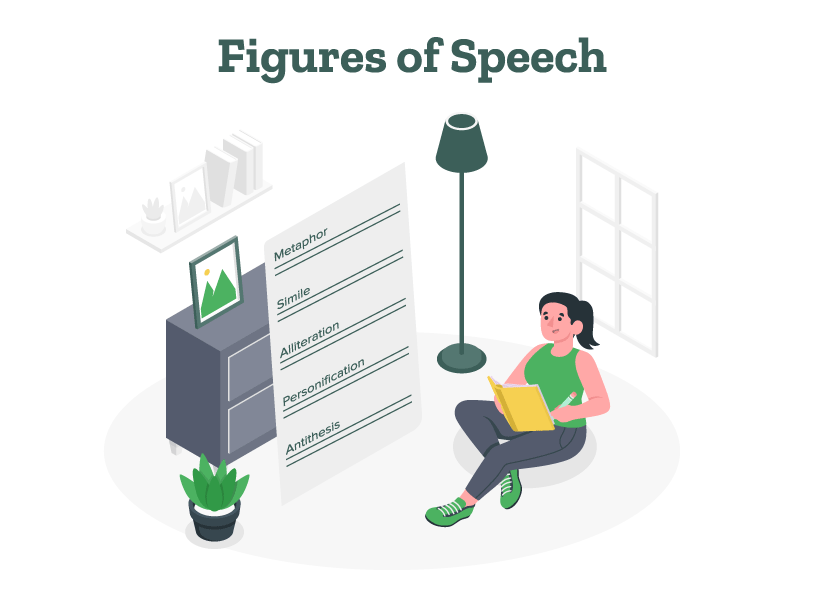
1. Metaphor 

A metaphor compares different ideas without using the words “like” and “as”. It shows a shared quality or feature between compared ideas. For example: 

The classroom was a zoo. 

In this example, a classroom full of noisy kids is compared to a zoo full of noisy wild animals. 

2. Simile 

A simile compares ideas using the words “like” and “as”. They help readers understand the thing described by relating it to something they already know. For example: 

The runner was as fast as lightning, racing towards the finish line. 

In this sentence, the runner’s speed is compared to lightning. 

3. Alliteration 

Alliteration is a writing technique where words starting with the same consonant sound are used in the same phrase or sentence together. It’s like a tongue twister that repeats the same letter or sound at the beginning of multiple words. For example: 

The big blue balloon bounced off the boy.

In the above sentence, the “b” sound is repeated at the beginning of multiple words. 

4. Personification

Personification is a figure of speech where human qualities, actions, or emotions are given to non-human things. It is different from anthropomorphism where non-human things are not only given human traits but also act like humans. Here are some examples of personification: 

The sun smiled down on the children playing in the park.

In the above example, the sun is given the human quality of smiling. 

5. Antithesis 

Antithesis is a figure of speech where two opposite ideas are placed together in a sentence to create a contrast. Think of it like a seesaw, with one idea on one side and the opposite idea on the other side. For example: 

It can be used to highlight a point, create a dramatic effect, or make a statement more memorable. For example: 

My brother is tall, but I am short.

In this example, two opposite ideas of tall and short are placed in the same sentence to create a contrast. 

6. Hyperbole 

Hyperbole is a figure of speech that uses exaggeration to make a point. When you use hyperbole, you describe something as being much bigger, better, worse, or more intense than it really is. For example: 

I’m so hungry, I could eat a horse! 

Here, the level of hunger is exaggerated to emphasize it and make a point. 

7. Onomatopoeia 

Onomatopoeia is a figure of speech where sounds are described to create an effect. They help to make the description more engaging. For example: 

The soda fizzed and hissed as it was poured into the glass. 

In this sentence, the words “fizzed” and “hissed” describe the sound soda creates. 
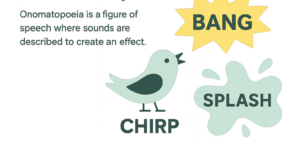
Sounds like chirp, bang, splash are examples of Onomatopoeia as a figure of speech.

8. Anaphora 

Anaphora is a writing technique where the same word or phrase is repeated at the beginning of multiple sentences. This helps to create an effect. For example: 

He ran through the forest. He ran over the hills. He ran until he couldn’t run anymore.

In the above sentence, the phrase “He ran” is repeated to create an effect. 

9. Allusion 

An allusion is a brief, indirect reference to a famous person, place, event, literary work, or work of art. Allusions can add depth and meaning to a piece of writing. Let’s browse through an example to understand better! 

He was as brave as Superman when he stood up to the bully.

Here, Superman is an allusion to the comic book superhero Superman. 

10. Paradox 

A paradox is a statement that seems contradictory or absurd but may be true in reality. It’s a situation or idea that appears illogical or self-contradictory. Here is an example: 

Less is more.

This paradox suggests that having less of something can actually be better or more effective than having more.  

11. Irony 

Irony is a figure of speech where the words one expresses do not mean what their literal meaning indicates but mean the opposite. Often, irony refers to a situation or fact that is opposite to what you would expect, often in a funny or strange way. It’s like a twist or surprise that goes against what seems logical or normal. For example: 

A dentist has bad teeth.

You would expect a dentist to have good teeth, so it’s ironic when a dentist has bad teeth. 

12. Euphemism 

A euphemism is a mild, indirect way of saying something that might be considered harsh, blunt, or offensive. It’s like using a softer or more pleasant word or phrase to talk about something unpleasant, embarrassing, or taboo. Here is an example of this: 

He passed away on 9th November 2002. 

Here, the word “passed away” is a gentler phrase for death, which can be a sensitive topic for many. 

13. Synecdoche 

Synecdoche is a figure of speech where a part of something is used to represent the whole, or the whole is used to represent a part. It helps to focus on a specific aspect of what is being described. For example: 

The stage was filled with talented faces. 

In the above sentence, the word “faces” (part) represents people (whole). Let’s see another example! 

“England won the World Cup in 1966.”

In this sentence, England (whole) represents the English national football team (part) and not the whole country. 

14. Litotes 

Litotes is a figure of speech where something bad/negative is said to highlight the positive/good. It is usually used in creative writing and in informal speech. For example: 

The party was not bad.

This means the party was actually quite good or enjoyable, but the speaker is understating it. 

15. Oxymoron 

An oxymoron is a figure of speech where two contradictory or opposing words are used to create a new meaning. When put together, two contradictory ideas express a unique or paradoxical meaning. For example: 

There was a deafening silence in the hall. 

Silence is the absence of sound, so it cannot be deafening. Deafening indicates an extremely loud noise. Hence, this is an oxymoron highlighting pin-drop silence. 

16. Apostrophe 

An apostrophe is a literary device in which a person addresses an inanimate object, someone, or something that is not there. It could be a person, an object, an abstract idea, or even a deceased individual. This writing technique is often used in poetry and dramatic works to express strong emotions, show closeness, or personify non-living objects.

Here is an example: 

“Oh, moon, why must you shine so brightly on this sad day?”

(In this example, the speaker is directly addressing the moon, even though the moon cannot respond.)

17. Transferred Epithet 

A transferred epithet is a descriptive word or phrase that is used to describe a noun. However, it’s not a word or phrase that would be usually used to describe that specific noun. For example: 

He walked on the lonely streets. 

The phrase “lonely streets” is a transferred epithet as streets can’t be lonely. “Lonely” is a word used to describe people. 

18. Metonymy 

Metonymy is a figure of speech where a word or phrase is used to highlight or focus on something related to it. In other words, it’s when you replace the name of something with a word closely associated with it. For example: 

I love reading Sidney Sheldon. 

In this example, “Sidney Sheldon” is used to represent the books written by him, not the person himself. 

19. Climax 

A climax is a figure of speech where ideas are arranged in the increasing order of their importance (ascending order). This creates a strong impression on the reader. Let’s see an example of this! 

The cricketer trained for months, overcame injuries, and finally performed well in the T20 Cricket World Cup. 

In this example, the ideas of training, overcoming injuries, and performing well are in ascending order. They reflect the cricketer’s journey. 

20. Tautology 

Tautology is a figure of speech in which an idea is repeated using different words that essentially mean the same thing. It’s an unnecessary repetition of a word or a phrase using synonyms and similar words. For example: 

She saw it with her own eyes. 

This sentence is an example of tautology as the word “own” is unnecessary since a person sees with their eyes. 

21. Circumlocution 

Circumlocution is a figure of speech in which a person uses more words than necessary to express an idea. The speaker or writer often uses a longer, more complex phrase or description to convey the same meaning. For example: 

“This particular area appears to be suffering from a notable lack of tidiness and organization.”

In the above example, the writer uses a verbose description instead of saying, “The area is messy”. 

22. Understatement 

An understatement is a figure of speech in which a person expresses an idea and makes it seem less important or serious. This is often done by using words or phrases that are mild, neutral, or positive. For example: 

“It’s just a scratch”. (to describe a serious injury.) 

23. Chiasmus 

Chiasmus is a way of writing or speaking where you switch the order of words or phrases. It is often used to create a sense of balance or contrast and can make the sentence more memorable. For example: 

“Ask not what your country can do for you; ask what you can do for your country.” – John F. Kennedy

In the above sentence, the order of the words “what your country can do for you” is changed. 

24. Epigram 

An epigram is a short, clever, and memorable statement that often expresses a general truth or observation. Epigrams are typically concise and thought-provoking. For example: 

“Little strokes fell great oaks.” – Benjamin Franklin

This epigram suggests that small, consistent efforts can overcome even the greatest challenges.

The final technique in our figures of speech list is polysyndeton. Let’s explore this technique in detail! 

25. Polysyndeton 

Polysyndeton is a figure of speech in which a writer uses multiple coordinating conjunctions (such as “and,” “or,” “but,” or “nor”), even when they are not grammatically necessary. This creates a rhythmic effect. For example: 

I searched high and low, near and far, over and under, but I still couldn’t find my keys.

In the above sentence the repetition of conjunctions like “and” creates a rhythmic effect. 

Now let’s see some figures of speech examples from well-known books! 

Nine amazing examples of figures of speech  

1. Simile 

      • “Loving someone is like moving into a house,” Sonja used to say. – A Man Called Ove by Fredrik Backman
      • Words are like tiny bombs, Liesel. – The Book Thief by Markus Zusak
      • “Her hair was like spun gold.” – Rapunzel by The Brothers Grimm

2. Personification 

        • “The wind howled through the trees.” – The Wind in the Willows by Kenneth Grahame 
        • “The flowers danced in the breeze.” – Alice’s Adventures in Wonderland by Lewis Carroll 
        • “The waves crashed against the shore, as if angry at the land.” – The Old Man and the Sea by Ernest Hemingway

3. Paradox

        • “Some rules are made to be broken.” – The Outsiders by S.E. Hinton 
        • “All animals are equal, but some animals are more equal than others.” – Animal Farm by George Orwell 
        • “You need to spend money to make money.” – Rich Dad Poor Dad by Robert Kiyosaki 

While these examples show how figures of speech can be used in creative writing, this is not all. Let’s understand how to use figures of speech to improve daily conversations! 

How to use figures of speech to enhance everyday conversations?

The following figures of speech can be used to make daily conversations engaging: 

          • Hyperbole: This figure of speech can be used to make conversations fun or convey distress. 

For example, instead of saying: “I have a lot of work to do”, you could say: “I’m drowning in a sea of paperwork!” (conveying distress) 

Another example is the sentence: “My internet is so slow, I could drive faster than it takes to load a webpage!”

      • Irony: This involves saying the opposite of what you mean to be witty. If it’s pouring rain and someone says, “Lovely weather we’re having,” the irony adds a touch of humor to the situation.
      • Rhetorical question: Asking a question you don’t expect an answer to can make people think. Instead of “This is important,” you could ask “Isn’t this something we should all care about?” You can use this literary device to discuss any sensitive, important issue that needs attention. 
      • Allusion: Making a quick reference to a shared culture (a book, movie, song, etc.) can create a sense of connection and understanding. You can use this when you meet friends, family, and acquaintances with whom you share similarities. For example, 

“This situation feels like something out of a Shakespearean tragedy.”  

This allusion to Shakespeare can be used if you and the reader/writer are aware of Shakespearean tragedies. 

The figure of speech in literature

Figures of speech have been used in literature for centuries to create powerful, evocative, and memorable works.

In literature, figures of speech can be used to:

  • Create vivid imagery: Figures of speech like similes, metaphors, and personification can help to create vivid and memorable images in the reader’s mind.
  • Convey complex ideas: Figures of speech like allegory, symbolism, and irony can help to convey complex ideas and themes in a way that is both subtle and powerful.
  • Evoke emotions: Figures of speech like hyperbole, understatement, and oxymoron can help to evoke emotions in the reader, from excitement and joy to sadness and empathy.
  • Create tone and atmosphere: Figures of speech like alliteration, assonance, and consonance can help to create a specific tone and atmosphere in a piece of writing, from playful and humorous to serious and somber.

To conclude, figures of speech are useful speaking and writing techniques for communication. By using figures of speech while writing, you can make your text more engaging. Save this guide for quick access to the figures of speech definition and examples! 

Once you complete writing, editing the text is crucial. As a trusted provider of editing and proofreading services, PaperTrue can easily help you polish your text. 

What did you think about this article on the different types of figures of speech? Share your thoughts in the comments section! 

Here are some useful resources for you: 
How to Write an Essay Header: MLA and APA Essay Headers

A header for an essay is an important part of APA or MLA formatting guidelines. In this article, we’ll find out the purpose of an essay header, how to format it, and the APA and MLA essay header variations.

A properly formatted header helps your professor quickly and easily identify your essay. In APA format, the essay header also carries a gist of your larger topic, providing the reader with basic information about your essay in one glance.

Let’s take a more detailed look at how to write a header for an essay.

Ensure top-notch essay formatting!

What is a header in an essay?

A header for an essay is a line of text typically included at the top of the page. The content of the header depends on your essay header format. The MLA essay header includes your last name, whereas the APA essay header includes a shortened title of your essay.

The use of a header is especially important in longer essays, as it helps professors navigate the document with ease. The page number helps them locate specific information quickly, and the author’s name helps them associate each essay with the student who wrote it. If you are still unsure how to structure your essay when writing an academic paper, consider reaching out to essay writers for assistance. Professionals from PapersOwl can help you craft a well-structured essay and ensure your work meets academic standards.

MLA essay header

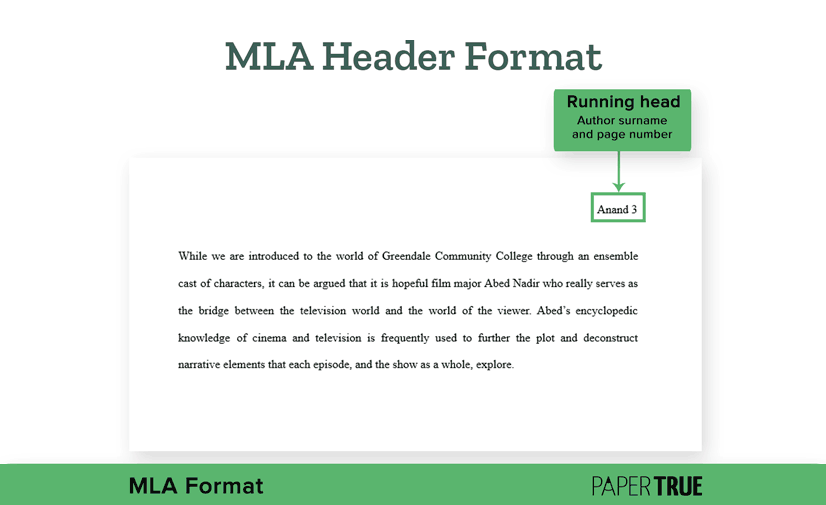
The Modern Language Association (MLA), often used in literature and humanities essays, requires a specific type of header. It consists of your last name, followed by a space and then the page number. Thus, the MLA essay header helps the instructor easily associate your work with you amidst a sea of other assignments.

The header for an MLA format essay is typically placed in the top right-hand corner of each page of the document. The information is right-aligned, double-spaced, and is usually preceded by a 0.5-inch margin. 

Here’s an essay header example to help you understand:

MLA header with a last name and page number included on the top right corner of the page.

It is important to note that the MLA essay header is not the same as a title page. The title page is a separate page that includes the essay title, your name, the course title, and the date of submission. The MLA format essay header is simply a standardized way to format page numbers and your personal information within the document itself.

APA essay header

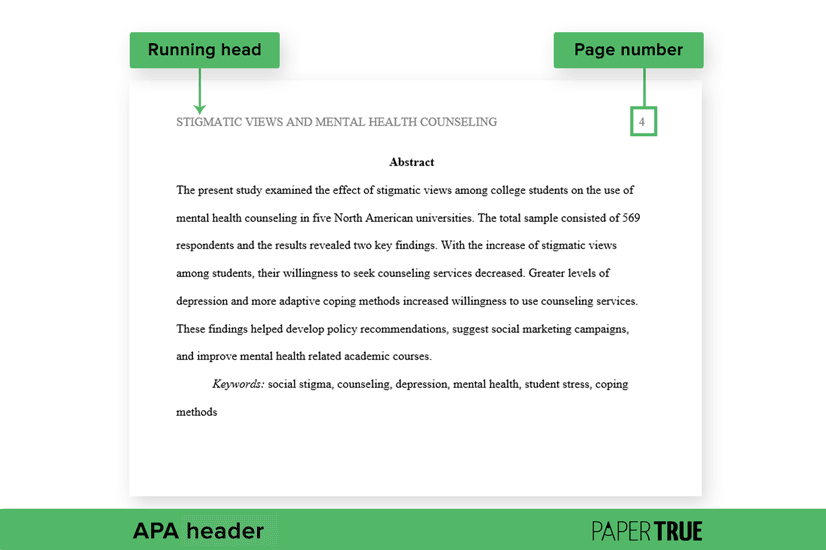
The American Psychological Association (APA) usually requires a header to be included in both student and professional essays. The APA essay header includes an abbreviated title of the essay along with the page number.

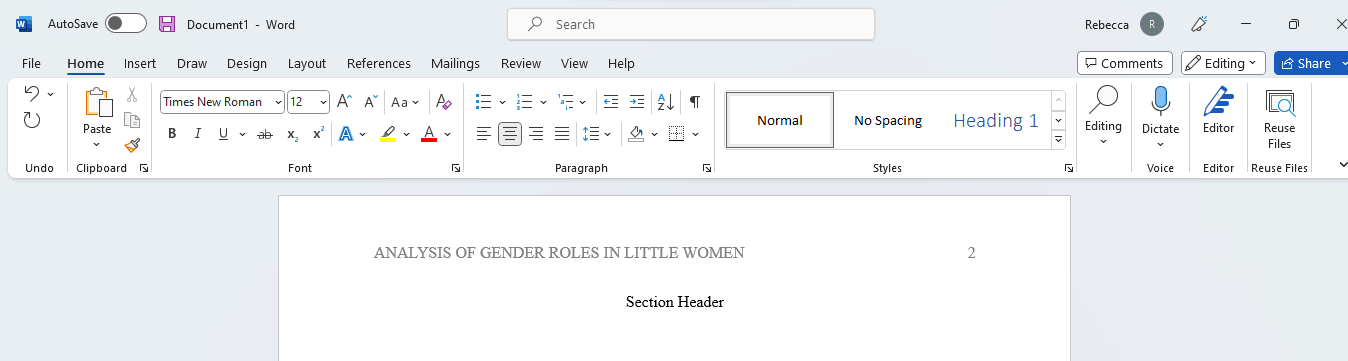
The title should be in all capital letters and should not be more than 50 characters long. It should be included on the top left corner of the page. The page number should be included opposite the title, in the top right corner of the page.

Take a look at this essay header example:

APA header with the title at the top left corner of the page and page number at the top right corner of the page.

It is important to note that running head in an APA essay header is optional for students but compulsory for professionals. While the header must be present in both types of APA essays, the elements differ.

How to write a header for an essay

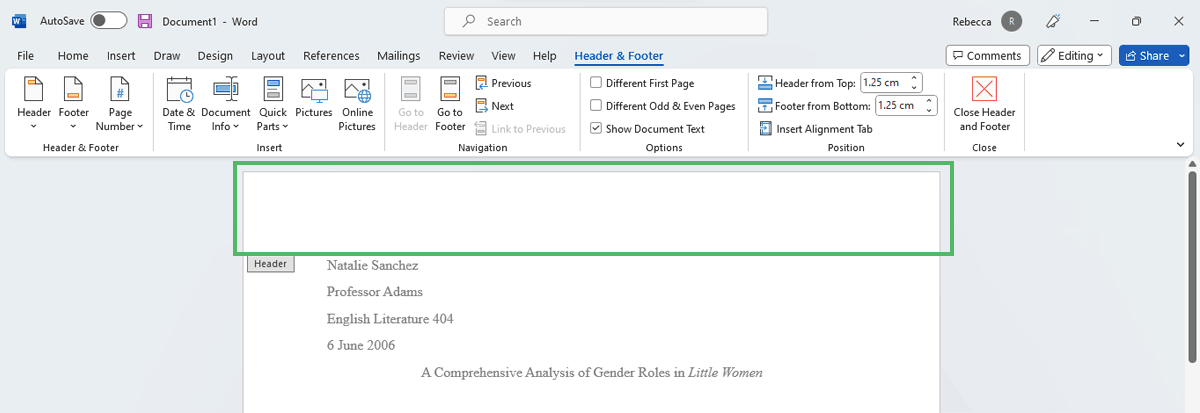
1. To activate the header for an essay, double-right-click on the top of the page.

First step of the essay header formatting. Double right-click on the top of the page2. Select the “Insert” option at the top of your window.
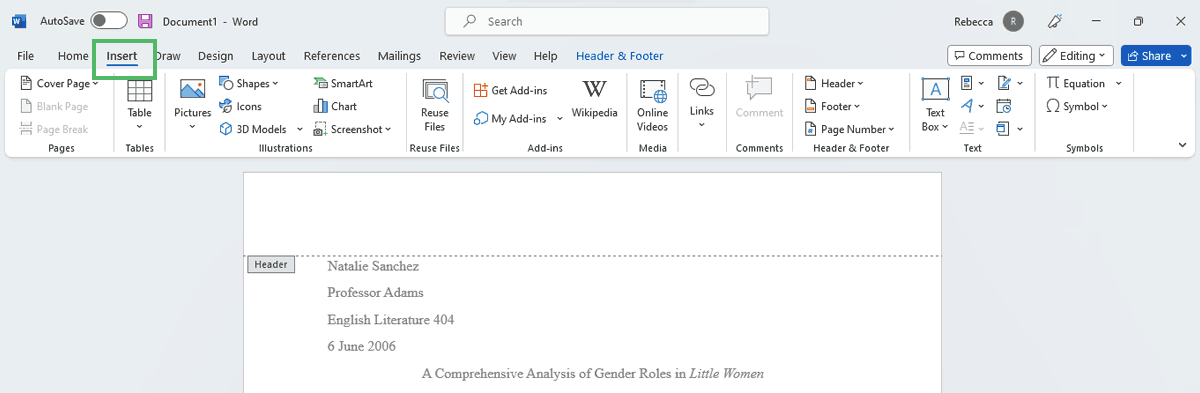
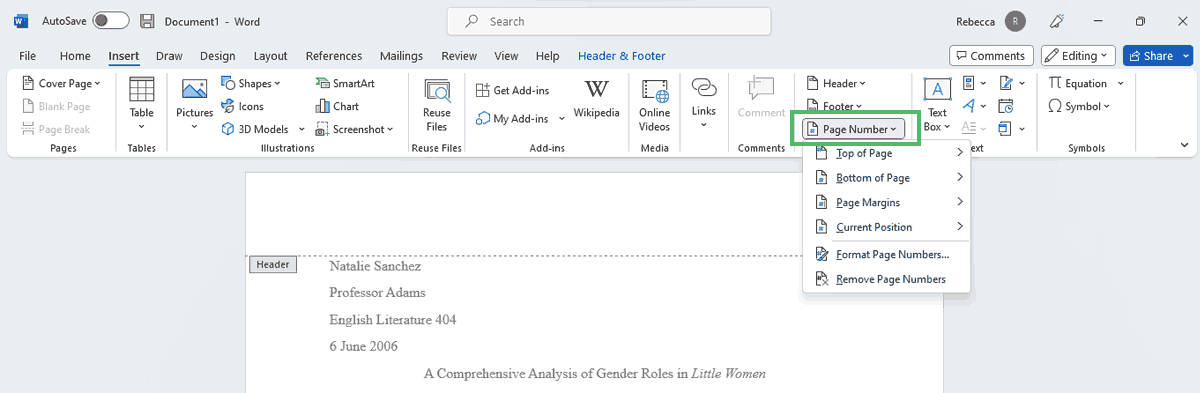
Second step of the essay header formatting. Click on the “insert” option3. Click “Page Number”.

Third step of essay header formatting. Click on the “page number” tab under the “insert” option

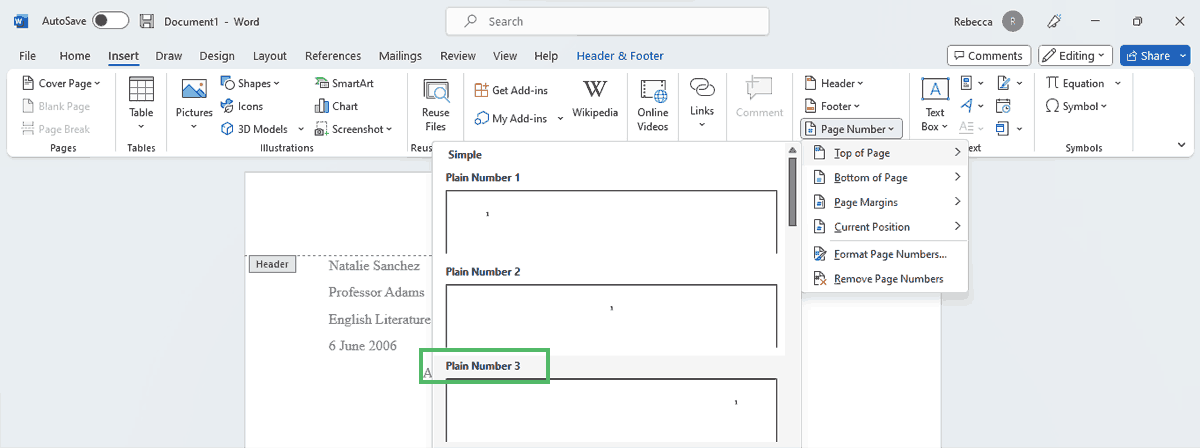
4. Hover over “Top of Page” and select “Plain Number 3”.
Fourth step in essay formatting. Click on “top of the page” option under the page number tab5. For the MLA header, enter your last name along with the page number, both right-aligned. For the APA header, input the abbreviated version of the title in all capital letters and press the “Tab” key.
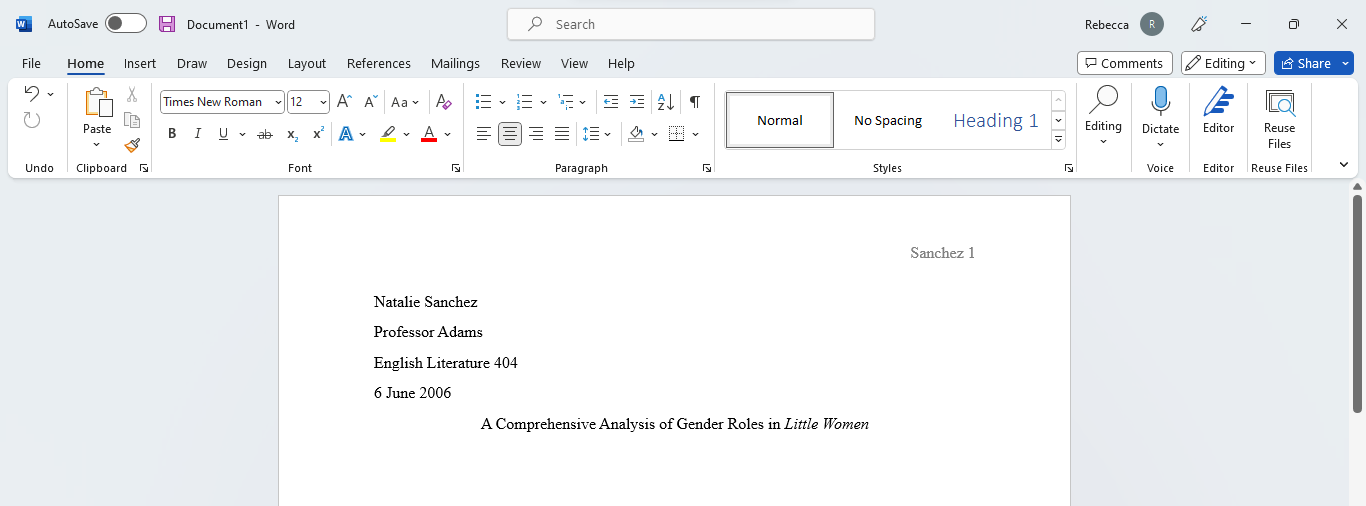
Features an MLA header example with the last name of the student and page number mentioned at the top.
MLA essay header example


Features an APA header example which the title at the top left and page number at the top right of the page
APA essay header example

If you need additional help with headers and other formatting guidelines, you can also consider working with a professional essay editing service. 

Want to keep reading? Here are the newest articles we’ve worked on:

What Is Worldbuilding? Steps, Tips, and Examples

Have you ever lost yourself in fantasy fiction, plunging into an alternate realm full of magic, advanced technology, and possibility—one with a unique culture and geography of its own?

Did you dream of writing a fantasy novel or series of your own and building a mystical world full of mystique and adventure?

Well, you’re in the right place—here is a complete guide to worldbuilding, along with steps, tips, and practical examples!

Have a Manuscript Ready? Begin Your Publishing Journey Today! Get Started

What is Worldbuilding?

Worldbuilding is the art of creating a fantasy world of your own, complete with its own history, geography, economy, culture, and system of government. Whether it is a magical world or a technologically advanced one, it is ultimately a fictional world that is unique and distinct in its own way, and forms the basis and environment for your fantasy novel or series.

The following is a set of step-by-step guidelines that will help you focus on the various aspects of worldbuilding to create a believable fantasy world of your own.

How to Start Worldbuilding

Pick your setting type

  • Decide on your world’s setting—do you want your story to be set in the real world (eg. the Outlander series by Diana Gabaldon), do you want to create an entirely new world (eg. Middle Earth in the Lord of the Rings series by J.R.R. Tolkien), or would you prefer to create a blended world (eg. the Harry Potter series by J.K. Rowling)? 
  • If you find yourself getting stuck, consider using free online tools like Reedsy Plot Generator to help you combat writer’s block.
  • Maintaining a list of points on the notes app on your phone or in a notebook will help you plot the elements you want in your fictional world.

How to pick setting in worldbuilding

Name your world/region 

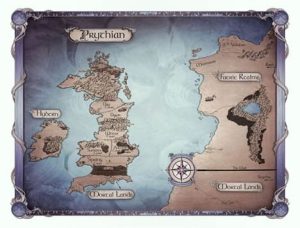
Next, it is important to give your world/region a catchy name and define its premise in one sentence. Some memorable examples from contemporary fantasy literature include Prythian (a land of fairies that exists north of the human world, from the A Court of Thorns and Roses series by Sarah J. Maas), Westeros, Essos, Sothoryos, and Ulthos (continents created by George R.R. Martin for A Song of Ice and Fire and its allied series), and Panem (a dystopian version of North America in the future created by Suzanne Collins for her Hunger Games trilogy and its prequels).

Naming world or region in Worldbuinding

Draft a one‑page ‘world pitch’

Once you have the basics of your fantasy world nailed down, it is time to write a ‘world pitch’. Some points to focus on are where the world is situated, the characters who occupy this world and their positions within it, in what way it is different from reality as well as other fictional worlds, and why it matters to your characters situated within it.

A step‑by‑step worldbuilding guide

Once you are clear about the basics of your fantasy world, here are some prompts you can use to build in-depth detail to add more dimension to it.

Map and geography

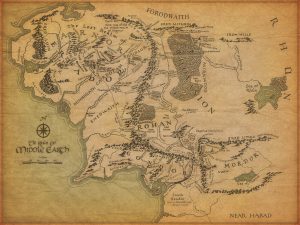
When it comes to plotting the geography of your fictional world, it is always a good idea to begin by drawing a map. Plot various landmasses, rivers, mountains, and plains, and decide the climate of each region. It is a good idea to begin sketching the coastal outline first, then add mountains, and finally add rivers and seas. As a bonus, this map could even feature at the beginning of your book, as is often the case with fantasy novels!

Climate and ecology

The climate of your fantasy world is important as it affects and influences the stories of your characters. You can plot out the climate and ecology by planning out climate zones, prevailing winds, ocean currents, and how climate shapes biomes and travel. It is a good idea to place mountains in areas of higher latitude and use the formula latitude + mountains = rain shadows to place deserts.

People and cultures

Just like in the real world, not everybody speaks the same language or follows the same culture. It is important to create a diverse population that speaks different languages, has different naming styles and customs, values and taboos, festivals, food, and fashion. Great examples of the same can be found in the cultures of different courts in Sarah J. Maas’s A Court of Thorns and Roses series, and in the cultures of different regions in Westeros in the A Song of Ice and Fire series by George R. R. Martin. While it is perfectly fine to draw inspiration from real-life communities to build your fictional ones, it is important to avoid harmful stereotypes and prejudices.

History and timelines

Like the history of the real world, the history of your fantasy world must also consist of different eras, political rulers, and events, turning points that brought in major change, and so on. If you are confused as to where to start, it would be a good idea to build a 10-event timeline from past to present that directly impacts your plot. Make a list of defining historical incidents or famous personalities who directly affect your plot. It would also help to show how their actions have impacted your characters’ lives in the present day. 

Magic systems and/or technology

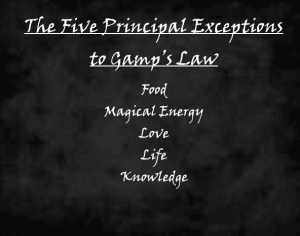
This is one of the most exciting parts of worldbuilding—showing how—through the existence of magic or advanced technology—your world is different from the real world. However, if magic or advanced tech were to exist and operate without any consequences or limits, there would be either a utopian world or complete anarchy. Hence, it is a good idea to show how magic/tech influences daily life, travel, war, medicine, etc., while also outlining five can/can’t rules and one meaningful cost. For example, in the Harry Potter series by J. K. Rowling, Gamp’s Law of Elemental Transfiguration states that something cannot be created from nothing; for example, while the quantity of food or beverage can be magically increased, it cannot be conjured from thin air. 

Magic and technology in worldbuilding

Economy and resources

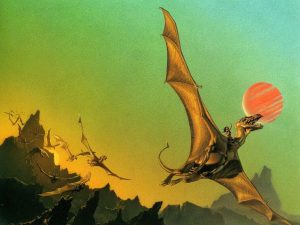
Like the real world, a fantasy world also has systems of trade, currency, and/or barter, and a variety of resources ranging from commonplace to valuable. It is important to outline a realistic economy and a list of resources with the relative value of each. It would also help to build a currency that can be used by your characters, for example, the ‘marks’ of Pern, a planet in Anne McCaffrey’s Dragonriders of Pern series. You can also outline methods by which the characters deal with scarcity caused by war/natural disasters/other conflicts to tie in with any potential conflict in your plot.

Power structures and religion

In most fantasy novels or series, a significant amount of conflict exists within structures of power—a despotic or corrupt government and an underground movement that seeks to topple it. Plot out a one-page ‘faction sheet’ listing goals, resources, allies, and conflicts, and outline government forms, factions, law or order, dominant religions, and their roles, as well as important ranks within the government or religious authorities.

Power structure and religion in what is worldbuilding

Best worldbuilding tips

Here are some tips to keep in mind when you get started on your worldbuilding journey:

1. Think of unique and memorable names for people, places, languages, religions, etc. 

2. While your fantasy world has the right to follow its own rules, it helps to have some aspects mirror reality to serve as a sort of point of reference for your readers and to add relatability.

3. Keep a notebook to scribble down all your ideas related to your fantasy world and plot them out accordingly.

4. If you are not sure about how to arrange the geography of your world, draw a map and allow your imagination to guide you.

5. Consider incorporating magical beasts like dragons/chimeras to inhabit your world and play an important role in the protagonist’s story.

6. If you are not sure as to how to go about building your world’s history, consider taking cues from real history—for example, George R. R. Martin took inspiration from the War of the Roses between the houses of York and Lancaster to construct the conflict between the Starks and Lannisters in his Game of Thrones series.

Worldbuilding checklist

Examples and mini case studies

Now that you have understood how to build your own fantasy world, here are some examples you can study for greater understanding:

1. The wizarding world in the Harry Potter series and the Fantastic Beasts movies—both written by J.K. Rowling—which exists alongside the ‘muggle’ or ‘real’ world.

2. The fairy world of Prythian in Sarah J. Maas’s A Court of Thorns and Roses series is independent of the human world and has its own government, power, and social structures etc.

3. The world of Narnia in the books of C. S. Lewis, which can be accessed through the back of an old wardrobe, is in many ways different from the ‘regular’ world.

4. Panem in Suzanne Collins’s Hunger Games books—a dystopian version of North America set in the future.

5. The planet Pern in Anne McCaffrey’s Dragonriders of Pern series was originally colonized by humans from Earth who have since forgotten their roots.

Example of planet in worldbuilding

Worldbuilding tools and resources

Templates & Bibles

If you’re not sure where to get started, consider using an existing fantasy world (or two, or three) as sites of inspiration. Study the way the author has constructed climates, regions, characters, cultures, languages, etc., and see if you can draw inspiration from the same. Of course, your own world must be unique and not copied from any author’s existing creation. The fantasy world of Westeros and Essos created in George R. R. Martin’s works is a good place to start, as it closely mirrors the medieval world while differing significantly in its own ways, weaving in magic, mystery, and mythical beasts to add to its grandeur.

Mapping and climate helpers

If you are planning to take inspiration from the earth’s own climate to create that of your fictional world, consider using websites like Techgeo, which can help you understand the different climate zones, their vulnerabilities, geography, topography, and nearby waterbodies.

Organization tips

It is a great idea to keep a notebook or a mindmap on software such as Spreadsheets or Google Sheets, where you can organize and plan your notes and story at large. Maintain information on people, places, things, and plotlines so you can connect them all together as you see fit.

Creating a fictional world is an exciting process, and we would love to help you get it right. The right kind of locale can inspire wonderful adventures for your characters, and perhaps provide the scope to enlarge a novel into a whole series.

PaperTrue offers expert, hassle-free self-publishing services that allow you to get your manuscript edited and published by professionals. Check them out!

Here are some more resources:

How to Create Marketing Material

Creating effective marketing material is vital for any business that wants to connect with its audience, convey a specific message, and achieve measurable results. It is one of the key pillars of business success. Marketing materials are the tools that brands use to communicate their value and invite customers to take action. 

In this guide, we will explore what marketing material is, outline steps for creating it, and share tips for developing high-quality, impactful content that resonates with your audience.

Is ineffective marketing material killing your business? Let experts edit it. Learn more

What is marketing material?

Marketing materials are any content a business creates to promote its brand and drive engagement. 

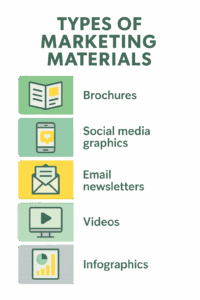
Through these materials, businesses keep customers informed about the latest offerings, promotions, and industry trends. Common examples include brochures, social media graphics, email newsletters, videos, and infographics, among other things. 

Each type of marketing material serves a distinct marketing purpose, whether it is to build brand awareness, drive sales, educate potential customers, or reinforce customer loyalty. A successful piece of marketing material captures attention, delivers a compelling marketing message, and encourages action.

They not only enhance brand identity through consistent and high-quality content but also promote customer loyalty by communicating with the target audience and making them feel “seen”. Effective marketing materials can attract new customers, generate leads, and ultimately boost sales and revenue.

Types of marketing materials

Before you finalize your marketing strategy, you should ask yourself an important question. What are the essential marketing materials that can help you reach your target audience and drive conversions? 

Understanding the types of marketing materials available is crucial for selecting the right one for your marketing objectives. 

Here are some common formats:

Types of marketing material

  • Brochures: They provide in-depth information and are ideal for events, trade shows, or leave-behind materials in sales contexts. Both print and digital brochures are popular for the unique benefits they offer. 

  • Social media graphics: Used for quick engagement, brand awareness, and visual storytelling on platforms like Instagram, Facebook, and X, social media graphics can leave a lasting impression. However, it is important to be cautious about what is portrayed on social media platforms since the Internet can make or break the reputation of your business with just one post. 
  • Email newsletters: Perfect for building ongoing relationships with customers and providing regular updates, promotions, or exclusive offers, email newsletters can boost revenue by accelerating sales.
  • Videos: Videos are excellent for demonstrations, tutorials, storytelling, or sharing customer testimonials, especially on visual platforms like YouTube.
  • Infographics: Great for presenting complex data in a visually engaging way, infographics simplify information for easy understanding and shareability.

Each format serves a unique purpose. By choosing the appropriate type, you can maximize the impact of your marketing material and cater to audience expectations effectively.

Steps to create engaging marketing material

Building effective marketing material involves several key steps, each contributing to a seamless alignment between the brand’s goals, the customer’s needs, and the intended message. 

Here’s how to create marketing material that stands out and drives results.

1. Define your marketing objective

The first step is understanding your marketing objective. What do you want to achieve with this material? Common goals include increasing brand awareness, driving sales, informing or educating customers, and building customer loyalty. 

Defining the marketing purpose is essential because it shapes the content and tone of your material. Are you introducing a new product, encouraging sign-ups, or promoting a seasonal offer? Once you know the goal, you can tailor your content to deliver the desired outcome.

2. Understand your target audience

For marketing material to be effective, your intended audience must connect with it. Start by identifying who your audience is. What are their demographics, preferences, pain points, and motivations? 

A well-defined customer persona helps ensure that the content you create addresses your audience’s needs and interests. 

For instance, marketing to millennials might involve a vibrant, socially conscious approach, while targeting executives might require a professional, concise tone. Identifying and decoding the likes and dislikes of your audience allows you to create more relevant, engaging content that’s likely to inspire action.

3. Choose the right format

Selecting the format of your marketing material is a crucial decision. Each type of marketing material serves a unique purpose and has its strengths:

  • Brochures give detailed information.
  • Social media graphics boost engagement.
  • Email newsletters prompt relationship building.
  • Videos and infographics promote storytelling and concept or product simplification. 

Consider where the material will be distributed—whether print, online, or in-person—and choose a format that aligns with your audience’s preferences and the distribution platform specifications.

4. Create a clear and compelling message

Your marketing message should focus on a single key point and be delivered in clear, persuasive language. Avoid jargon or highly complex language that could confuse your audience. Instead, aim for a message that’s easy to understand and engages the reader instantly. 

These messages are the essence of your communication; they should resonate emotionally and align with your objective. Hence, keep the message clear, direct, and aligned with your brand’s voice across all marketing material types (promotional offers, informative pieces, videos, etc.).

5. Design with brand consistency

Consistency is key when it comes to building brand identity in marketing. Use your brand’s colors, fonts, logos, and other visual elements to reinforce your brand image. This consistency not only makes your marketing material recognizable but also helps establish trust and credibility with your audience. 

For instance, a healthcare brand might use a clean, minimalist design to convey professionalism and safety, while a children’s brand might incorporate bright colors and playful fonts.

6. Include a strong Call-to-Action (CTA)

A CTA is a crucial component of effective marketing material. Without a clear CTA, your audience might not know what steps to take next. Your CTA should be direct, actionable, and aligned with your marketing objectives. 

For example, if you are promoting a new product, your CTA could be “Shop Now.” If you’re building an email list, “Sign Up for Exclusive Offers” might be more appropriate. 

In this way, you can guide your audience toward taking the next step that supports your marketing objectives.

7. Use high-quality visuals

Visuals play a significant role in making your marketing material engaging and memorable. High-quality visuals, whether photos, illustrations, or graphics, should support the message rather than clutter the design. 

Images can evoke emotions, highlight product features, and make complex information easier to understand. When selecting visuals, ensure they are relevant to the content and maintain a high standard of quality.

8. Review and refine

Once your material is designed, it is essential to review and refine it. Proofread the text for any spelling or grammar errors and ensure it corresponds to your marketing purpose and brand voice. 

A professional marketing copy editor can be invaluable at this stage. They can help you polish the language and maintain clarity. Consider getting feedback from colleagues or trusted customers, as fresh perspectives can reveal areas for improvement.

9. Test and measure performance

If you are creating digital marketing material, analytics are your best friend. Use tools like Google Analytics, social media insights, or email marketing platforms to track your material’s performance. 

Key metrics to monitor include clicks, shares, conversions, and overall engagement rates. By measuring these metrics, you can identify what works and what needs improvement, allowing you to refine future campaigns and optimize results.

Additional tips for creating effective marketing material

Beyond the foundational elements of strong messaging, clear calls to action, and visually appealing design, here are some additional tips to improve the quality and presentability of your marketing materials:

  • Stay customer-centric: Always prioritize the needs and preferences of your target audience. When customers see that your material addresses their pain points, they are more likely to engage.
  • Use simple language: Even when marketing complex products or services, keep the language accessible. If possible, simplify technical jargon and present information in a way that’s easy to understand.
  • Consider timing: Certain types of marketing materials work best at specific times. For example, seasonal promotions can benefit from well-timed email newsletters, while social media posts may have optimal times based on your audience’s online activity.
  • A/B testing: For digital materials, consider creating variations of your content to see which performs better. A/B testing can help you refine elements such as headlines, CTAs, and visuals.
  • Build for mobile: Many customers access marketing materials on their smartphones. Ensure your materials are mobile-friendly to maximize accessibility and engagement.

Creating impactful marketing material requires careful planning, a deep understanding of your audience, and a commitment to quality. To enjoy the best possible results in a given situation, consider following these steps and focus on delivering a clear message with a strong call to action. Marketing materials created correctly can capture attention and build brand loyalty.

If you are a business in search of experts to polish your marketing materials, PaperTrue can help refine them. Our expert editors enhance clarity, maintain brand consistency, and give your content a professional edge. Explore PaperTrue’s editing and proofreading services and talk to us to know more.

Here are some articles that can help you create impactful marketing materials: 

Top 10 Free Essay Writing Tools for Students in 2025

Writing an essay seems less challenging once all relevant sources and ideas are in place. Several essay writing apps can help you generate an outline for essays. Moreover, you can use these apps to write your essay. In this article, we have listed the top ten essay writing tools that can help you improve your essay and get good grades.

When discussing essay writing apps, we mean essay writing and editing tools that improve your work, not apps that provide readymade essays. Many of the free essay writing tools available online are powered by Artificial Intelligence (AI). We do not encourage copying essays as that can bring about unsavory results. 

So, none of the tools that have made it to our list of top ten essay writing tools will help you cheat. They will, of course, help improve your essay to make it your best work. So, if you’re looking for a list of the best essay-writing tools, read on for detailed information.

Get an A+ with our essay editing services!

Top ten essay writing tools

Our top ten essay writing tools are a diverse list. They help you in various essay writing tasks such as planning your essay, writing it, improving it, and getting feedback when it’s complete. Here are the top 10 essay writing tools in 2024, including the best AI essay writing tools:

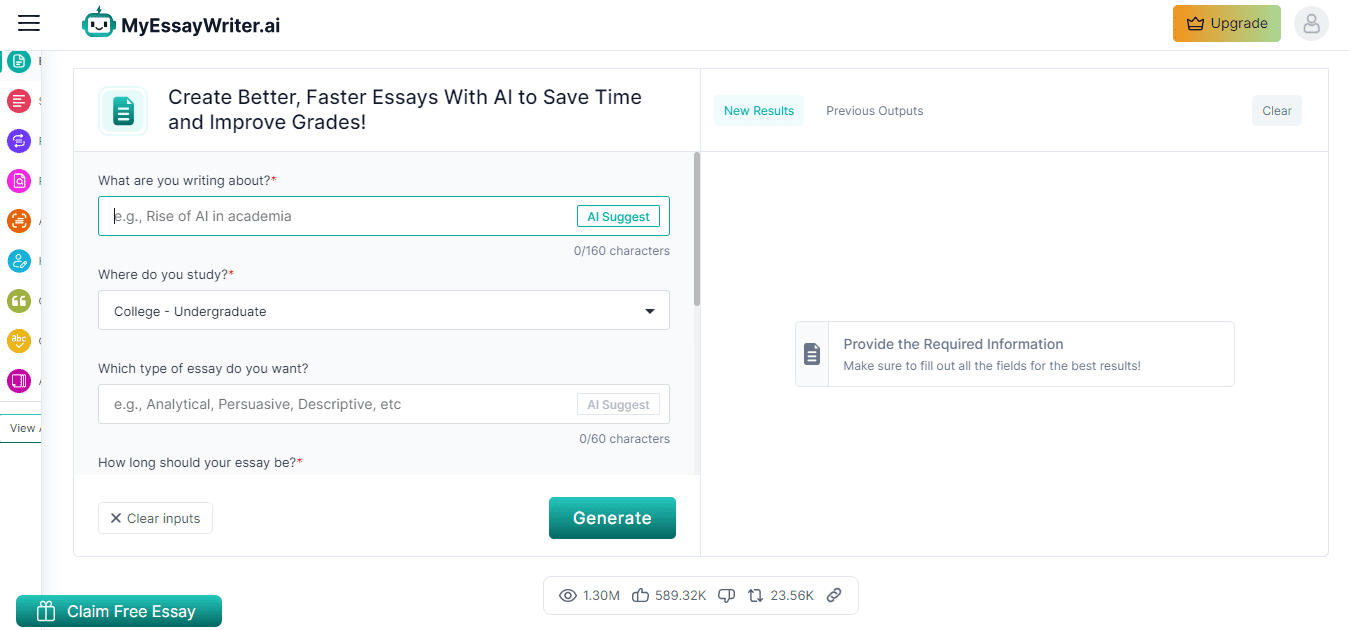
1. MyEssayWriter.ai

This is an AI-powered essay writing assistant designed for students. It provides personalized essays tailored to students’ specific topics and needs. As part of free services, the tool offers artificial intelligence-based essay outliners and writers. 

If you want a custom essay, you can place an order, and an expert will draft your essay for a fee. The rates depend on the academic level, urgency, and word count a student requires.

A high-school-level essay of 300 words returned within 7 days costs around $22. 

MyEssayWriter Essay writing tool.

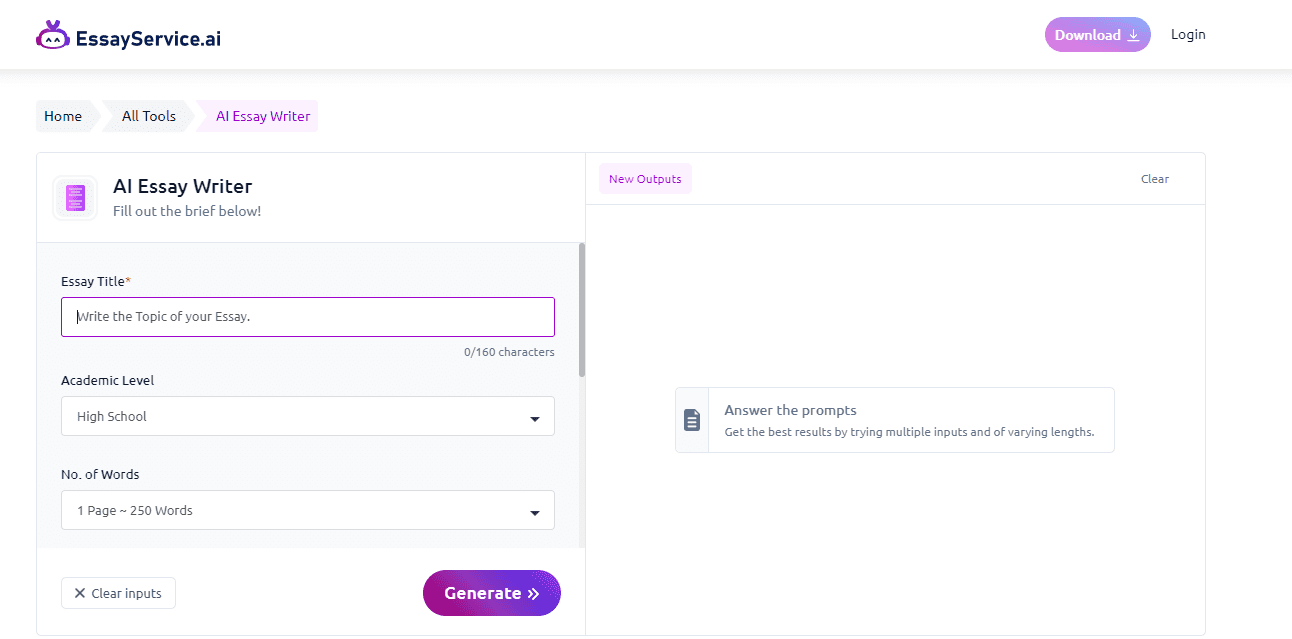
2. EssayService.ai

This is a user-friendly platform that offers various tools to improve essay quality. It includes real-time grammar and structure feedback and tone and style adjustments. It gives multiple essay generation options, with a free essay grader for students to have their essays checked.

The platform also offers a paid essay writing service, where you can calculate the charges by inputting information like essay type, number of words, and deadline, among others. 

A high-school-level essay of 300 words returned within 7 days costs around $22.

EssayService essay writing tool

3. Editpad

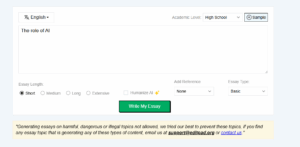
Editpad offers a freemium AI-powered essay writer that will not only help you craft well-written essays but also contribute to improving your overall skills. It allows you to select the academic level (high school, college, etc.) and type of essays (basic, descriptive, etc.).

To ensure maximum personalization, Editpad even gives the authority to select the length of the generated essay (Short, Medium, Long, and Extensive) as per your specific needs and preferences. 

Additionally, it generates up to 3 versions of the essay against a single prompt. This provides users with the opportunity to go with the version that they think is the most suitable one. 

The free version of EditPad has no usage limitation, but obviously, feature limitations are there. To unlock them, you will have to purchase the premium, costing $3.99 weekly.

Editpad essay writing tool

4. Essayness

Essayness is an advanced AI-powered essay writer that lets you generate a high-quality essay around any topic. You have the option to customize the word count and writing tone of essays as well. With these options, you can generate customized essays that are perfectly tailored to your needs.

Essayness allows you to specify the Reference style and number of citations to provide you with a more credible and authentic essay. Additionally, it offers the Humanize AI feature as well, which will generate more natural and human-like essays.

It is a freemium tool; available in both free as well as freemium versions. The free version of Essayness offers limited access to features. To unlock all the features, you need to subscribe to the premium plan that costs $12 /month.

Essayness AI Essay writer

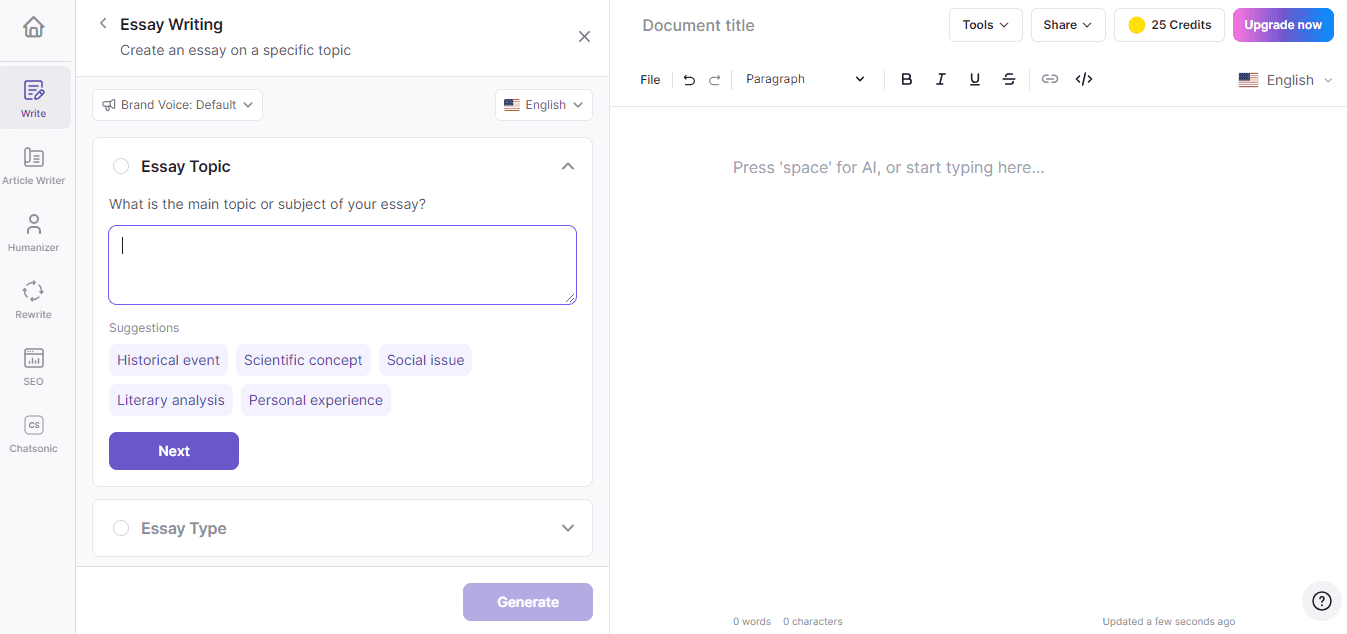
5. Writesonic

This is a content-creation tool, but it offers essay-writing features as well. It can generate essay outlines, introductions, and body paragraphs based on your input. The platform states that it provides plagiarism-free content. 

Writesonic can speed up the initial essay writing process and offer a basic structure for your essays. If you use this college essay writing tool judiciously, you can generate excellent essays that can get you the score you want. 

Chatsonic, which costs $12 per month if billed annually, offers a chat option with features similar to ChatGPT. 

Writesonic essay writing tool

6. ChatGPT

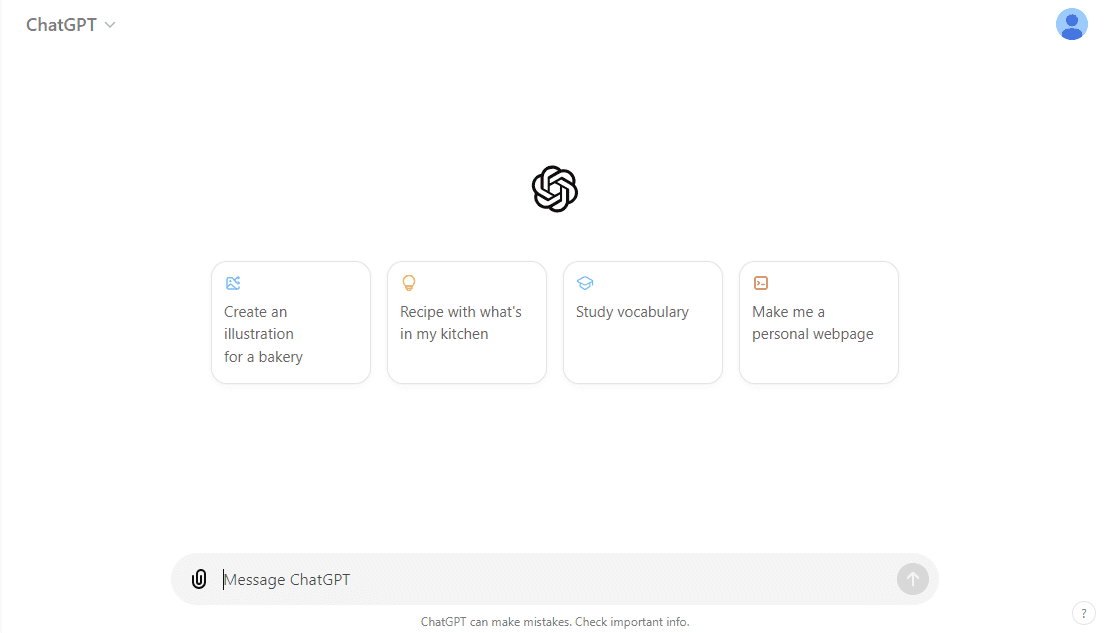
A powerful AI language model, ChatGPT, can help you draft essays with a few clicks. It can generate essays based on prompts and instructions for various topics. ChatGPT can also help you create essay outlines and arguments.

This is an ideal tool for brainstorming and exploring different writing styles. However, it is crucial to verify the content it generates to ensure factual inaccuracies do not go unnoticed.

ChatGPT Plus costs $20 per month with access to multiple versions of the platform.

ChatGPT essay writing tool.

7. Jasper.ai 

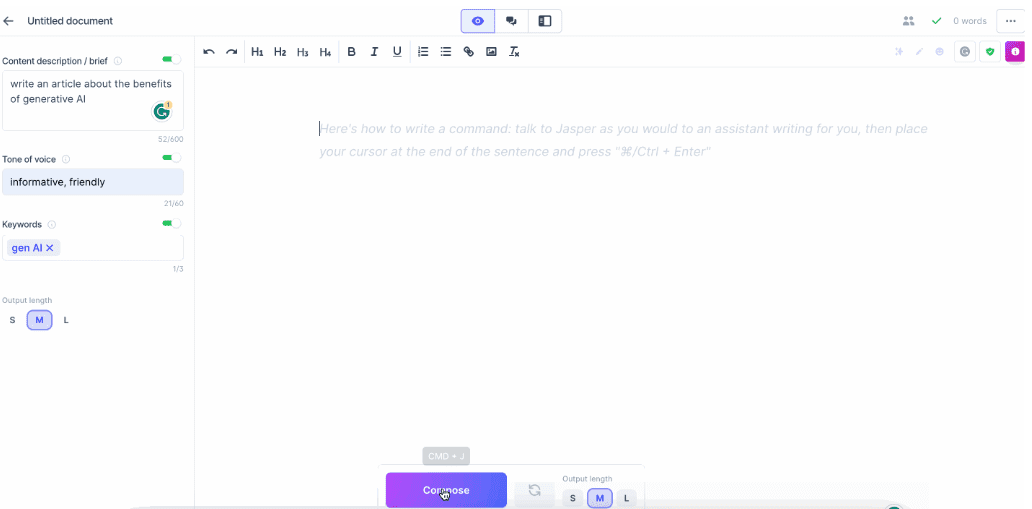
Jasper.ai is an AI writing assistant with features for creating various content formats, including essays. The copywriting tool allows users to write essays of all types, tailoring them to suit varied target audiences and writing tones. 

Since it offers long-form content generation with plagiarism checks, you can generate content of a certain depth. However, we recommend essay checking and editing to ensure quality.

Jasper’s “Creator” plan costs $39 per month for one-person access.

Jasper.ai essay writing tool.

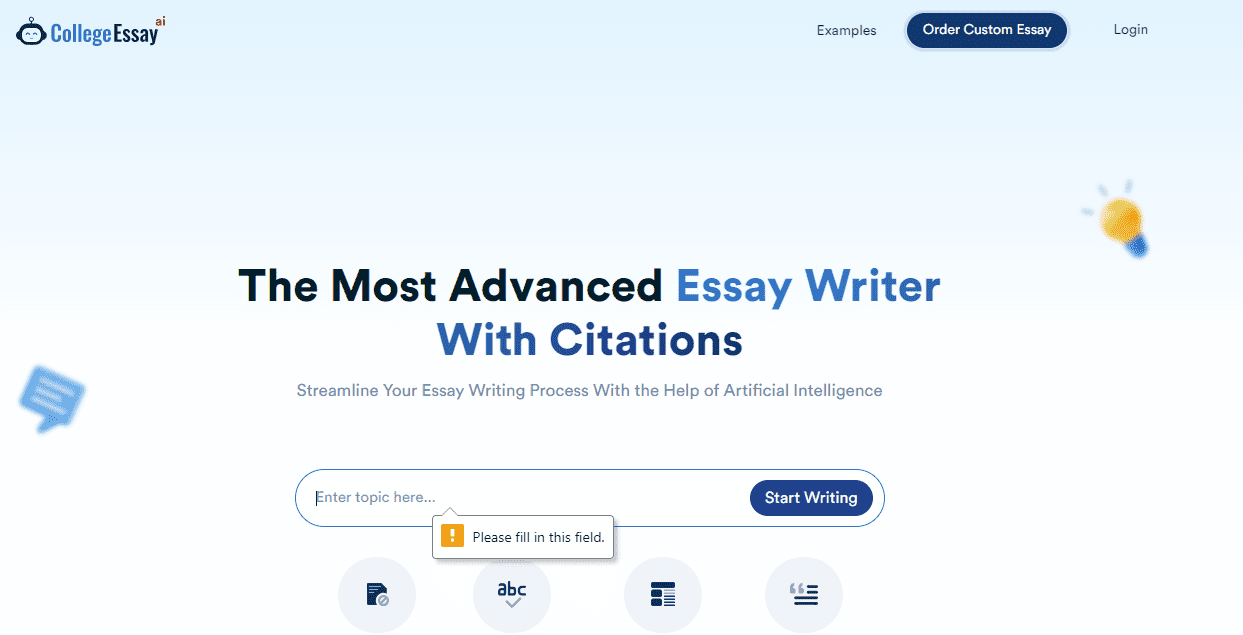
8. CollegeEssay.org

CollegeEssay.org offers an AI-powered essay writing tool designed to simplify the essay writing process for students. This tool uses advanced AI algorithms to generate free essays. It also offers grammar and plagiarism checks, in addition to a content paraphrasing tool

The platform also gives you the choice to order custom essays as part of paid essay writing services. However, free AI essay writing tools should do the job well if you are a student. 

A high-school-level essay of 300 words (considered one page) costs $11.


CollegeEssay.org essay writing tool.

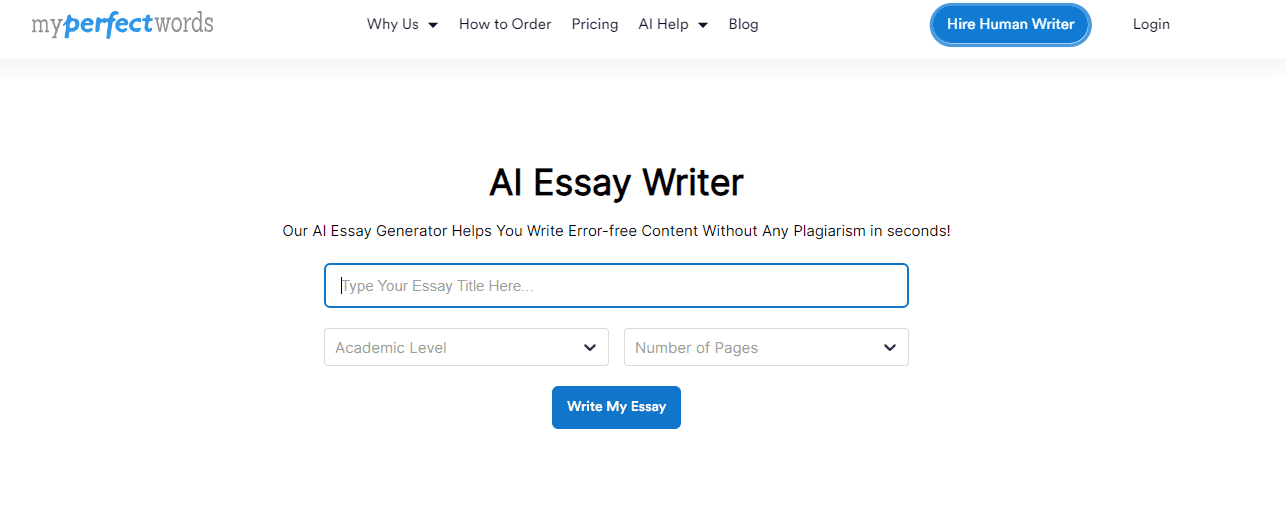
9. MyPerfectWords

This is an essay writing service with grammar and plagiarism checks, where you need to key in the topic and the relevant prompt. The essay writer then refers to multiple resources to write an essay using AI. 

Its citation tool can seamlessly integrate references relevant to your essay to ensure zero attribution issues.

A high-school-level essay of 300 words (considered one page) costs $11.

MyPerfectWords essay writing tool.

It’s certainly a great tool for any essay writer!

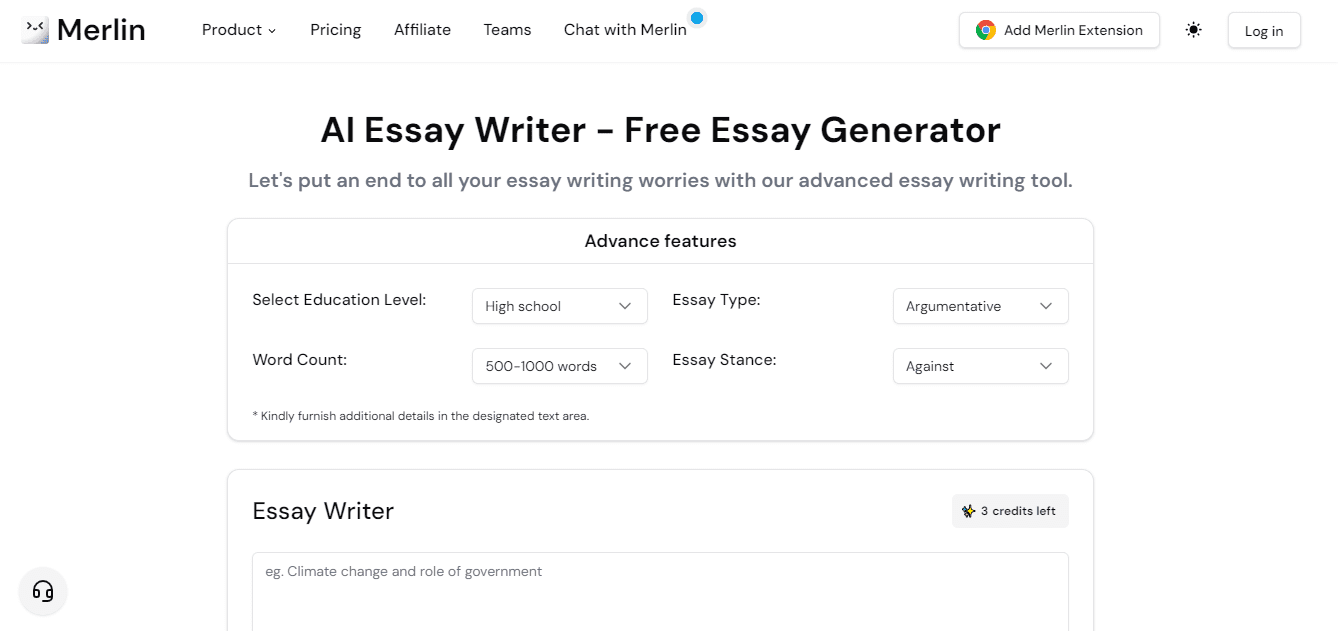
10. Merlin

Merlin brings users a comprehensive suite of writing tools, including essay writing. The tool asks you to specify the word count and academic level of the topic at hand, along with the essay-writing approach you wish to take. 

You can also review the generated content and modify the prompt/s to get different results. The platform shares pointers with users on how to ensure the integrity and accuracy of their content. 

Merlin’s free plan is quite beneficial for students since they allow 102 queries per day, and this limit resets every 24 hours. If you are interested in a paid plan, they offer the “Pro (Unlimited)” at a discounted price of $19 per month. The standard price without discount is $29.

Merlin essay writing tool.

Can writing tools help improve your essay?

Well, the short answer is that these tools certainly help. However, automated software might not always understand writing like human beings do. Hence, a human editor overseeing the job AI tools do can introduce more reliability to the essay writing process. This is because there’s no replacement for thorough research, critical thinking, and effective essay editing.

While you can use free AI tools to write your essay, seek essay editing and proofreading services offered by a company like PaperTrue. Once you’re done with your essay, just send it over to us for feedback before your submission deadline.

Want to keep reading? Here are the newest articles we’ve worked on:

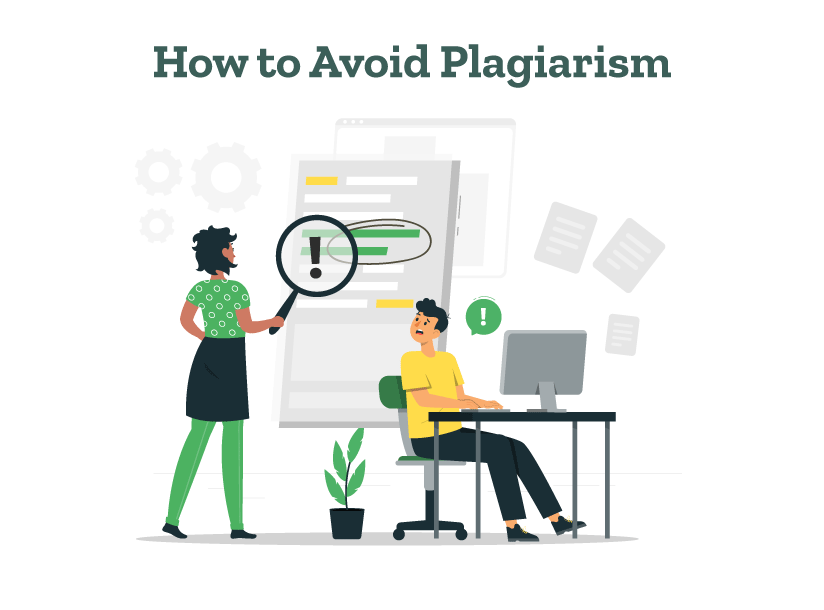
How to Avoid Plagiarism in 2025 (10 Effective Strategies!)

Plagiarism is the act of presenting someone else’s ideas or words as your own without giving proper credit. It’s a serious academic offense that can lead to severe consequences.

This comprehensive guide explores what plagiarism is, why avoiding it matters, and provides 10 actionable strategies to ensure your work remains original and properly attributed.

We’ve also included many free tools that can help you avoid plagiarism while writing!

Get your text edited and checked for plagiarism!

How to avoid plagiarism (10 strategies) 

1. Cite all sources accurately 

If you’re writing a thesis, dissertation, or research paper, use the given citation format (APA, MLA, Chicago, or other). Also, include in-text citations and cite the sources on the reference page as well. 

For direct quotes, use quotation marks and provide page numbers when applicable. You can also use citation generators like Citation Machine, Zotero, and BibMe to generate accurate citations. However, always double-check automated citations against your style guide, as these tools occasionally make mistakes.

2. Paraphrase  the content in your own words

Paraphrasing doesn’t mean only using synonyms of some words to make the text different. It involves understanding the main idea and changing the entire sentence structure. For example, if the sentence in the source starts with, “The person is…”, ensure that the sentence you use does not begin with, “The person is…” 

Start by reading the source material thoroughly, then set it aside and write your understanding from memory. This technique helps ensure you’re expressing concepts in your own words rather than unconsciously mimicking the original text.

The following are some ways to avoid plagiarism by paraphrasing: 

      • Combine related ideas in a single sentence or split a long sentence into two parts. 
      • Summarize important information and keep the most important idea. 
      • Use alternative phrasing by referring to the One Look dictionary at https://www.onelook.com. This dictionary can give you alternative phrasing after you describe the phrase you’re looking for. 

If you’re having difficulty paraphrasing, you can use advanced AI paraphrasing tools like QuillBot, Paraphrase.io, WordAI, and SpinBot. 

3. Understand the types of plagiarism 

Plagiarism involves not only using others’ ideas but also reusing your own work without citing the original source. If you’re rearranging the order of sentences from a source or combining ideas from multiple texts to create a new work, it can also constitute plagiarism. 

Mosaic or patchwork plagiarism combines phrases from multiple sources without proper attribution, while accidental plagiarism results from poor note-taking or unfamiliarity with citation standards.

Knowing the various types of plagiarism helps you identify potential issues in your writing before they become problems.

4. Use plagiarism checkers 

Plagiarism checkers serve as valuable safety nets, identifying potential issues before submission. Free tools like DupliChecker, Small SEO Tools, and Grammarly’s plagiarism detector can catch unintentional similarities. For more comprehensive checking, consider premium services like Turnitin or Copyleaks, which compare your work against extensive databases of academic papers, websites, and publications.

Run your work through these tools during the writing process, not just at the end. This allows you to address issues as they arise rather than facing major revisions later.

5. Give your unique perspective 

Consider how your personal experiences or expertise can contribute to the topic. Another method is to use your research to develop your arguments and give new perspectives rather than simply summarizing others’ ideas. Though these steps to avoid plagiarism take research and reflection, they are useful in the long run! 

Also, when illustrating your points, use original examples or case studies that you have developed yourself. This can help you avoid over-reliance on the examples provided in your sources. 

6. Use library resources and online academic resources 

Libraries subscribe to a wide range of online databases that provide access to scholarly articles, journals, and other credible sources. You can use these resources to recheck the original author of a source to avoid plagiarism. JSTOR Open Access, Project Gutenberg, and Directory of Open Access Journals are some popular online libraries you can use. 

You can also use academic research resources like PubMed and Google Scholar that credit the original authors. This will help in avoiding plagiarism. 

Now let’s understand how can you avoid plagiarism by tracking and organizing sources! 

7. Track and organize all sources 

Create a systematic approach to tracking sources from the beginning of your research.

You can use reference management tools like Zotero, Mendeley, and Citavi Free (Windows) to organize references. Alternatively, you can create a separate folder of your references on your computer that has a list of references, including the original author’s name, source name, date accessed, URL, and DOI (if any). 

To avoid plagiarism, you should also take notes on key ideas and include specific page numbers for references. You can use writing tools like Evernote, Google Docs, OneNote, Simplenote, or Zoho Notebook to take notes. 

Using different colors, fonts, or symbols in your notes can help prevent confusion later. This organization proves invaluable when you need to verify citations or locate specific information.

8. Recheck, proofread, and add/correct citations

To understand how you can prevent plagiarism, follow the steps given below: 

        • Read through your work to make sure that your language is easy to understand. 
        • Compare your in-text citations with your reference list to ensure that every source mentioned 
        • Double-check that any direct quotations are enclosed in quotation marks and that the source is properly cited. 

Now, let’s understand how to prevent plagiarism through effective communication with people belonging to the same field. 

9. Engage in discussions

Participate in class discussions, online forums, or study groups to share your ideas and learn from others. Engaging in dialogue can help you refine your own perspective and generate new ideas for your writing.

Document these discussions in your notes, as they can become valuable sources of original thinking for your writing.

10. Take feedback 

Consult with your instructor, supervisor, or librarian if you have any doubts or questions about avoiding plagiarism or citation practices. You can also ask students or experts in the same field to resolve your doubts. 

This concludes our guide about the steps to prevent plagiarism! You can bookmark this article to revisit these 10 tips about how to avoid plagiarism. 

Common plagiarism pitfalls and how to avoid them

Even conscientious writers can inadvertently plagiarize. Common mistakes include forgetting to cite common knowledge that’s actually field-specific, inadequately paraphrasing complex technical language, or assuming that citing once covers multiple uses of the same source. Stay vigilant about these potential issues and err on the side of over-citation when in doubt.

This concludes our guide about the steps to prevent plagiarism! Remember that academic integrity reflects your commitment to scholarly excellence and professional ethics. The effort you invest in avoiding plagiarism not only protects you from serious consequences but also strengthens your research skills.

After understanding the ways to avoid plagiarism, select the relevant steps to prevent plagiarism, or if you want to save time, you can use PaperTrue’s plagiarism-checking services. Along with checking plagiarism, we also provide expert editing and proofreading services

Do you have any other tips for avoiding plagiarism? Share any other strategies to prevent plagiarism in the comments section! 

Here are some other useful resources for you: 

Worldbuilding Questions and Templates (Free)

Whether you’re building a fantasy, sci-fi, or dystopian world, building a compelling and believable world is of the essence. With various categories such as geography, politics, society, power structure(s), climate, culture, language(s), and many more, your world is your playground, and your word is law! 

Our specially curated guide offers 100 questions across categories to help you build an immersive world for readers to lose themselves in.

Got Your Fantasy Manuscript Ready? Get It Published Today! Learn More

100 category-wise worldbuilding questions

Here are some questions you should be asking to build the different parts of your fantasy world:

Geography 

1. What is the geographical layout of your world, and what are the major landforms?

2. How do the different climate zones affect the seasons and cultures of your world?

3. Are any landforms sacred or forbidden to certain cultures? Explain why, and any religious beliefs/superstitions surrounding these.

Politics 

4. Is your world an autocracy, a democracy, or a dictatorship? Who forms the government?

5. What are the major laws and taboos that govern your world?

6. Are any laws controversial or likely to cause rebellion?

Flora and fauna

7. What are the different species that exist in your world, and how are they unique/different from real life?

8. What are their lifespans?

9. What are their diets/restrictions, if any?

Culture 

10. What are the defining features of your world’s culture(s)?

11. How many different cultures are there, and how do they interact with each other?

12. Do they have any specific beliefs/myths/holidays/practices?

Language 

13. Is there a common tongue used by the inhabitants of your world, or are there languages specific to various regions?

14. What are their writing styles?

15. What are their cultural values, and how do they differ from region to region?

Magic or technology

Magic or technology worldbuilding template

16. What kind of magic/technology is used on a daily basis?

17. Is any kind of magic/advanced technology regulated or feared?

18. Do types of magic/technology vary from region to region?

Economy 

19. Does your world have a currency, or does it function on the barter system?

20. What are the most/least valuable resources?

21. Does your world have more capitalist or socialist leanings?

Arts

22. What are the major art forms in your world, and how are they viewed/valued by society?

23. Who are the performers, and how are they perceived by society?

24. How do the performers and art forms interact with structures of power? For example, are there court poets or jesters?

25. What are the musical traditions of your world?

26. What are the dance traditions of your world?

27. What are the fine arts traditions of your world?

28. Are any art forms prized over others?

Knowledge and education

29. Who in your world has access to education?

30. How do they acquire their training/education? Do they go to an institution of learning, or are there apprenticeships?

31. What are the disciplines they are educated in, and how does this affect or influence their career options?

32. Are there particular examinations/tests that they have to take to be considered masters/experts?

33. What are the various levels of expertise (eg, apprentice, master, etc.) that exist? How do they attain these levels?

34. What does the typical student–teacher relationship look like?

35. Are there any customs surrounding initiation into (a particular branch of) learning?

36. Do education opportunities differ for males and females?

37. What are some skills/knowledge that every adult is expected to have?

38. Does your world have libraries? If so, what are they like?

Daily life 

39. What does a typical home in your world look like?

40. What are the different strata of society?

41. What does a day in their life look like?

42. What is the cuisine like, and what are the food habits of the inhabitants of your world?

43. How do they acquire basic necessities like bread, water, etc.?

Worldbuilding templates

Here are some templates you can use to guide your worldbuilding process and help you gain clarity with regard to the kind of questions you should be asking:

One‑page pitch

Here are some questions you should ask to summarize your world at a glance:

44. Where is your world located, and who are its inhabitants?

45. How is your world different from the real world? What sets it apart?

46. What are the defining conflicts/crises of your world, and how do the main characters intend to solve them?

47. What are the rules and regulations of your world, and do your characters follow or break them?

48. What does your world’s system of government look like?

Event timeline 

Your world’s history plays a major role in its present events. It could also affect the background of your characters, the factions they belong to, and their motivations. Here’s a brief template to map the history and plot-relevant events of your world: 

49. Define the major eras of your world, their pivotal features, and the outcomes of major events that occurred during these eras. 

50. Plot major keystones or turning points that shaped the history of your world.

51. Elaborate on recent upheavals that played a role in disrupting your world and directly influenced the events of your story (eg, revolution, war, plague, etc.)

Magic/technology rules 

Magic or technology rules worldbuilding template

Not sure how to go about building the magic or advanced tech that forms a major part of your fantasy world? Here is a template to help you form a logical basis for your world’s systems:

52. What are the rules and limitations that govern the use of magic/tech?

53. What are the costs of crossing certain limits/using forbidden magic/tech?

54. How does one acquire skills and knowledge?

55. Who has access to this magic/tech?

56. How does this affect society at large?

Factions

Most fantasy worlds consist of rival factions, often with different agendas and political goals. Here are some questions to ask yourself to comprehensively outline each faction:

57. What are their goals? What do they stand for?

58. Who is their leader? What is his/her/their history and motivation?

59. Where are they based, and where do they operate out of?

60. What are the resources at their disposal?

61. Who are their allies and rivals?

62. What led to the founding of this faction, and how long has it been since then? Have their goals/mode of operation changed or evolved since then?

63. What would it take to start an uprising?

64. How are uprisings planned and executed?

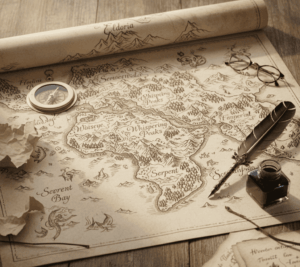
Map-based template

A good strategy to follow when building the geography of your fictional world is to go from the ground up. 

Map worldbuilding template

Here is a template to follow to ensure you get your geographical features right:

65. Where are your continents positioned, and how many are there?

66. Where do your mountain ranges lie? Tip: They can form natural barriers against invasions.

67. Where do your major wind routes come from, and how do they affect the climate of the areas they flow into?

68. What are the major ocean currents, and how do they influence trade and migration?

69. Where do the rivers and wetlands lie, and how do they influence agriculture, food habits, and settlements?

Society

70. What does it mean to be a child in your world?

71. What does a typical childhood look like?

72. Are there any rites of passage to transitioning into adulthood?

73. How large is the typical family in your world?

74. Is marriage the norm, and if so, what are some marriage traditions?

75. Is your world patriarchal, matriarchal, or equal?

76. Are there any rites/customs surrounding the birth of a child?

77. What are some commonly used first names, and how are they derived?

78. What are some commonly used last names, and how are they derived?

79. What is the typical family set-up like in your world?

80. How are elders addressed?

81. What are any rituals/practices surrounding death?

82. Does your world have hospitals/a healthcare system?

83. How is the life of the nobility?

84. How is the life of the upper class?

85. How is the life of the middle class?

86. How is the life of the lower class?

87. What does it mean to be homeless in your world?

88. What are some commonly pursued hobbies?

89. What is the dressing style of the nobility?

90. What is the dressing style of the upper class?

91. What is the dressing style of the middle class?

92. What is the dressing style of the lower class?

93. Is it possible to transcend class boundaries?

Infrastructure

Infrastructure worldbuilding template

94. What does your world’s transportation system look like?

95. What do the houses/palaces/castles of the nobility look like?

96. What do the houses of the upper class look like?

97. What do the houses of the middle class look like?

98. What do the houses of the lower class look like?

99. Does your world have a military/guards/a security system?

100. What are some public facilities available?

Worldbuilding plays a major role in crafting the universe you set your story in. They influence the characters, their backgrounds, and their journeys, and create a stunning visual backdrop in the mind’s eye—a well-described fictional world can provide an almost cinematic experience for the reader. We hope our template helps you create the fantasy world of your dreams!

PaperTrue offers expert, hassle-free self-publishing services that allow you to get your manuscript edited and published by professionals. Check them out!

Here are some more resources:

Top 101 Bone-Chilling Horror Writing Prompts

A good horror story often includes elements of surprise, psychological depth, and diverse influences from both classic and modern works, making it truly chilling. If you love writing scary stories, this article is for you! Dive in to discover the best 101  horror writing prompts for your next masterpiece. From creepy ghost story ideas to supernatural horror, we’ve covered everything for you. 

For Halloween enthusiasts, we have also added a special section of horror story prompts. The horror genre is a rich field for creativity, offering various storytelling techniques that invoke strong emotions and shock. You can use these prompts for Halloween to craft suspenseful and engaging stories. So let’s get started! 

Perfect your spine-chilling tale!

Horror writing prompts 

1) A sleep tracker app reveals you’ve been leaving your house every night at 2 AM and walking exactly 2.7 miles, but you have no memory of it. When you check security footage, the person leaving isn’t quite walking—they’re gliding an inch above the ground.

2) A psychologist suggests a new therapy to a patient, after which the patient starts getting scary nightmares.

3) A marine biologist discovers that whales aren’t singing to communicate—they’re chanting a warning. When she decodes the message, it’s a countdown in an ancient human language that predates civilization, and it reaches zero in three days. 

4) A hunter sees a blood-sucking vampire in Albanian forests and flees to save his life. 

5) You inherit your grandmother’s recipe box and decide to bake her famous cookies. Each person who eats one becomes obsessed with finding her grave—and when they do, they start digging with their bare hands, whispering “She’s not finished yet.”

6) A girl finds an ancient key and unlocks a box, releasing 20 monsters who had been imprisoned for 500 years. 

7) A mother purchases an antique dollhouse with Chinese dolls for her daughter and realizes that the dolls are haunted by cursed spirits. 

8) A strong current pulls a fisherman into the ocean’s deep waters. The fisherman sees a ship and manages to climb onto it, only to realize that it is a phantom ship. 

9) A boy is followed by the shadow of death everywhere, leading to death wherever he goes. 

10) A gardener finds an ancient telephone while digging in the garden and accidentally contacts aliens using that telephone. 

11) A tattoo artist notices that a particular design keeps being requested by different clients who’ve never met. Each person who gets the tattoo disappears within a week, and the artist discovers the same symbol carved into trees surrounding an abandoned psychiatric hospital.

12) A child breaks a magical snow globe and hears screams. Suddenly, there is heavy snowfall, and hailstones begin falling hard from the sky. 

13) A priest opens a locked room in a church and releases the ghosts of dead scientists who want revenge. 

14) A thick fog suddenly envelops a tiny village, and a wicked witch who feeds on sorrow enters the village. She enchants dead bodies and makes them obey her commands. 

15) A girl starts having dreams of what will happen in her future. To her horror, every dream comes true, and she must act before the dream of her death becomes a reality. 

16) During a DNA ancestry test, you discover you’re a 100% match to a body found in a peat bog that’s been dead for 3,000 years. Archaeologists are baffled, but you start having memories that aren’t yours—and a growing hunger for something raw and ancient. 

17) A poacher is haunted by the spirits of animals whose skin he has sold. 

18) A woman takes a free lift from a man who is a demon in disguise. Attracted to her, the demon takes her to the land of demons. 

19) A museum adds a new artifact to its collection without realizing that the object is cursed and belongs to an ancient tribe. Angry, the tribe performs black magic on all the museum’s employees, who must face torture till the artifact is returned to its rightful owners. 

20) A crime scene cleaner finds the same child’s handprint at every unrelated job site across the city. The print is always in blood, always in impossible locations, and it’s getting fresher each time. 

Three ghosts are near a spooky castle on the outskirts of a forest.

21) A librarian sees a young girl who was supposed to have died in 1913. The young girl asks for the librarian’s help to take revenge against a powerful man. When the librarian refuses, the angry girl unleashes horror into the librarian’s life. The librarian begins seeing blood on the walls and hears creaking sounds, scary footsteps, and a hand that reaches out to kill her. 

22) A businessman doesn’t honor the promise he made to a poor man. He suddenly realizes that all the bad incidents that the poor man experienced are now happening to him. 

23) You move into a new apartment where the previous tenant left all their belongings, including a journal. The entries describe your life with perfect accuracy—but they were written five years ago and end abruptly with tomorrow’s date.

24) A government employee visits an orphanage for a survey and finds out how every child is controlled by a satanic cult. 

25) A crazy and gifted musician creates an eerie tune that enchants and forces people to kill other people. 

26) Every mirror in a newly renovated hotel shows the room as it was during a fire that killed twelve people in 1968. Guests can see themselves in the present, but also their burning reflections screaming silently from the past.

27) You enter an abandoned house, and the door slams shut on its own. You realize that you are trapped in that house and see a strange yellow light. 

28) You find a key to a magical land of history, and a dragon follows you from the historical land to the earth. 

29) An actress is kidnapped by a witch who wishes to manipulate her and control the world. 

30) An investigator who tries to find out the truth behind a college student’s murder realizes that the boy invoked supernatural forces before dying. Now, the investigator must stop the supernatural forces from killing him and other humans. 

31) A scientist discovers a door to the land of memories and accidentally damages the memory of his identity, forgetting everything he knows about himself. 

32) A neurologist develops a procedure to delete traumatic memories. Her patients report success, but she starts seeing the deleted memories—literal shadowy figures that act out the traumas, growing more solid and violent with each procedure performed.

33) You work the night shift at a 24-hour convenience store where the same customer comes in at exactly 3:47 AM every night, buys the same items, and leaves. One night, you follow them outside—but there’s no one there, and the purchased items are back on the shelves.

34) A magician has the rare gift of bringing dead people in paintings to life. Chaos spreads after the magician brings Hitler to life by working magic on a painting. 

35) A horrible black monster steps out of the Atlantic Ocean and begins eating everything it sees. 

36) A teacher finds an old coat that belonged to a demon in the past. Every time he checks the coat pocket, he reads news of people dying. Hours after he reads the notes, the people mentioned in the notes die, and blood spots keep appearing on the coat. 

37) A beggar walking close to a forest finds a trail of notes and happily picks them up. Later, he realizes that the notes belonged to wedding guests who died in an accident. The ghosts of the wedding guests notice that he has picked up the notes and haunt him. 

39) A sorceress trapped in an enchanted mirror manages to control a young girl who pulls her out of the mirror. 

40) A team of psychic youths is hired to find and fight a ruthless demon who feeds on despair. They must make a terrible sacrifice to prevent the demon from knowing their darkest secrets. 

41) A lady discovers an old well near the flat she is renting. She peeps to see what is inside the well, and a half-human, half-animal hand grasps her neck. 

42) A journalist arrives at her flat and finds a scary message written in red ink on her mirror. The message reads,”‘I’m coming for you!” and somebody has drawn a smiling face with red ink on the mirror. 

43) An angel is given the task of saving the world from a deadly plague. An army of tiny demon bacteria fights the angel and tries to force him to go back. 

44) A man desperately tries to remove his car, which is stuck in a swamp. Suddenly, he sees a muddy, ugly, hairy creature raise its head from the swamp. 

45) A camper suddenly sees a little girl sleepwalking with an evil smile on her face and blue sparks flying from her hands. 

47) Imagine that Pandora has a human heir called Nymphadora who opens a box she discovers. Tiny creatures that have feelers like needles step out of the box and make an attempt to stop time and the wheel of destiny. 

48) You wake up and discover that you are 40 years old, whereas the day before, you were just 19. 

49) A couple who are hiking enter a village where no one speaks and everyone has pale yellow eyes. 

50) A traveler accepts a drink from a tribal an,d after drinking it, falls into a deep sleep. The next day, he realizes that he is in a large cage with animals, and the tribals are dancing around the cage. 

51) You’re attending a masquerade party in a snowy area where everyone is dressed as animals. You see a large, hairy, ape-like animal and recognize that it’s a real Yeti. The Yeti, realizing that you know his true identity, wants to kill you. 

52) A wicked group of vampires lands on Earth with a mission to kill all humans and settle on Earth. They enter your house and want to kill you and your family. 

53) A couple has rented a room in a palace to spend the night. While using the elevator, the elevator suddenly stops midway, the light starts flickering, and the couple hears screams. 

54) An archaeologist discovers a document about cursed gold and becomes obsessed with finding the gold. His quest leads him to the cave where a wicked witch lives. 

55) You discover an ancient diary that contains strange incantations. When you read them aloud, Satan appears. 

56) An antique typewriter types messages on its own, but only during thunderstorms. The messages are pleas for help from people who will go missing in the coming week. You can save them, but the typewriter demands a replacement name for each one you rescue.

57) An injured man finds an old, abandoned clinic and enters the clinic, hoping for treatment. He is confronted by a zombie that has made the clinic its home. 

58) A boy presses a magical button that makes him travel in time. Unfortunately, he chooses the wrong time portal and lands in an insane asylum. 

59) You see the face of a werewolf at your window’s glass. The werewolf breaks the glass, and you have a few seconds to escape. 

60) A boy finds a strange red device with a black button in the mud. The boy presses the button, upon which the people who are alive die immediately, and dead people start coming to life. 

Continue reading to get inspired by our special section of scary story prompts. Browse exciting prompts for horror stories from various genres like dark fantasy, psychological horror, and more! 

Scary story prompts 

61) Strange things happened to a teenager after he performed a planchette with a group of friends for fun. His car stops working, the bus he travels on gets punctured, and he is unable to return home. 

62) A scientist invents a potion to restore his youth. However, he makes a mistake while adding an ingredient to the potion. Hence, when he drinks the potion, his skin grows deformed, with white patches and thick fur. 

63) A horse rider discovers bones in an old stable. When he tries to burn the bones, the bones surprisingly do not burn. Instead, a thick white fog suddenly envelops the stable, and evil spirits emerge from the bones. 

64) A plastic surgeon becomes famous for making people look exactly like their “ideal selves.” But patients start noticing their old faces walking around the city, living better lives, and the faces are hunting down their original owners. 

65) A woman opens the door and finds a woman claiming to be her aunt. She also shows photographs as proof, and the woman allows her ‘aunt’ to enter the house. The aunt then gives the woman a strong potion, and the woman falls into a deep sleep. When the woman wakes up, she realizes that she is in the netherworld and sees beings with no light in their eyes. 

 A scary airborne doll is staring eerily.

66) An alpine skier has a terrible fall from a mountain. A group of nomads sees her and forcibly takes her to an old temple. They slit her leg with a knife and perform a strange ritual. 

67) You discover your childhood imaginary friend left a time capsule for you to open on your 30th birthday. Inside are photographs of you at places you’ve never been, with people you’ve never met—but you’re smiling in every single one, and there’s something wrong with your eyes. 

68) A researcher finds out about a rare tribe that can make themselves invisible and travel with lightning speed. While trying to find the tribe’s descendants, she suddenly finds herself face-to-face with their guardian, who tries to kill her. 

69) You enter a house where a psychic man has been staying in secret. When you confront the man, he uses his mind power to enchant all metallic objects, make them airborne, and position them to attack you. 

70) You come across a rare animal that can change its shape at will. To your horror, it suddenly changes its shape to look like you and tries to kill you. 

71) A boy returns to his remote village after a long time and realizes that all the villagers are hypnotized and have black marks on their hands. 

72) A lady never invites guests to her house and rarely ventures out of her house. A detective realizes that the lady’s life is manipulated by a cat who is a witch in disguise. The detective must save himself and the lady from the wicked cat. 

73) A man finds tapes that his girlfriend gave him before she died. He hears an eerie screeching sound in the background when he plays the tapes. To his horror, he hears the same screeching sound and scary footsteps after he stops playing the tapes. 

74) A student finds a hit list of people who will soon be killed. The list was created by a demon in disguise. The demon kidnaps the student to prevent him from telling anyone the truth. 

75) A girl hires a tutor to learn Japanese. One day, she realizes that her Japanese teacher transforms into a werewolf every full moon. 

76) A cave diving team discovers an underground lake where every sound they make echoes back as screaming. When they surface, they realize six months have passed topside, and their families have been receiving phone calls from them the entire time. 

77) A 12-year-old child sees a mysterious violet light streak across the sky. Whenever the light shines, somebody dies. 

78) An intruder touches an electric fence and is jolted by a strong current. Before his eyes close, he sees an ugly ghoul looking at him. 

79) A historian finds out about a rare voodoo practitioner who is the last of an ancient, mystic tribe. He arrives at the voodoo practitioner’s hut only to find the place ransacked and the voodoo practitioner gone. He suddenly sees ghosts floating in the air and hears a grandfather clock laugh menacingly. 

80) A food delivery driver keeps getting orders to the same address, but each time the house number changes street. They finally deliver in person and discover it’s their own childhood home—where a family who looks exactly like theirs did 20 years ago is eating dinner. 

Now, let’s see some scary story writing prompts about Halloween! 

Halloween horror prompts 

81) Vampires gatecrash a Halloween party, and terrified guests are unable to escape. 

82) A group of friends decided to have a scavenger hunt on Halloween. Suddenly, all the friends disappear one by one. 

83) A giant wakes up from a deep sleep on Halloween and stamps his foot in rage. This leads to an earthquake, and all guests at the Halloween party are in danger. 

84) An audiobook narrator records a horror novel, and strange things start happening during playback. Listeners report hearing extra voices whispering their names, and the narrator discovers they’re actually channeling the book’s villain, who’s been waiting decades for someone to give them a voice.

85) You hear an eerie tune on Halloween night and wake up in fright. Suddenly, you see the face of a big black bear outside your window. 

86) You accept a dare to visit a haunted house on Halloween. Suddenly, you hear screams and utensils falling in the haunted house. 

87) A family decides to punish their extremely naughty son and not celebrate Halloween. On Halloween night, the parents leave home due to an emergency, leaving their naughty son alone at home. 

88) A group of friends decides to sleep at a graveyard for fun on Halloween. Suddenly, they see ghosts emerging from the tombstones. 

89) You start receiving voicemails from your own phone number. The voice is yours, but older and terrified, warning you about specific choices you’re about to make. When you ignore one warning, you watch the consequences unfold exactly as described—and the calls start coming from your children’s numbers.

90) Write a short story on Halloween using the words phantom, nightmare, banshee, and voodoo. 

An angry zombie is preparing to attack a man.

91) A crazy scientist challenges a colleague on Halloween to drink a potion that he has created for an experiment. The colleague drinks the potion and starts shrinking. 

92) A meteorologist notices a storm system that appears on satellite but not on radar. It’s been following the same family for three generations, moving whenever they move, and it’s finally about to make landfall where they’ve settled.

93) A boy befriends an alien who wants to celebrate Halloween. When the alien arrives at the Halloween horror costume party, it gets scared and starts attacking everyone. 

94) A girl insults a tarot reader who makes a terrible prediction about her on Halloween. She continuously experiences bad luck, has an accident, and wakes up in the hospital. She realizes that she has forgotten her identity. 

95) A man befriends a she-banshee on Halloween, who grows extremely possessive about the man. Whenever anyone touches the man, the banshee kills him. 

96) A serial killer enters a Halloween party, and his next target is you. 

97) A group of friends enters a horror maze to celebrate Halloween and is trapped inside the maze. Suddenly, they are confronted by a real ghost who grins wickedly at them. 

98) An archaeologist unearths a fossilized human handprint pressed into 200-million-year-old rock—impossible, since humans didn’t exist then. When they touch it, their hand fits perfectly, and they begin remembering the asteroid impact that killed the dinosaurs from a perspective that shouldn’t exist.

99) You are a part of a ghostbuster team. You are given the secret task of capturing a dangerous ghost at a Halloween party. The dangerous ghost recognizes you, tries to kill you, and gets very violent. 

100) You meet a stranger at a costume party at a neighbor’s house for Halloween. Suddenly, the stranger touches you and whispers strange words in an unknown language. You are transported to an eerie land of spirits, ghouls, trolls, banshees, and zombies. 

101) You are hiking with a group of friends on Halloween. You see a black castle floating in the air. A ladder on the ground is positioned, leading to the door of the castle. You and your friend climb the castle, and the door slams shut. A wicked dwarf who is the castle’s caretaker tells you that you are trapped forever. 

We hope these horror story prompts inspire you to write your next masterpiece. Once you complete working on your scary writing prompts, the next step is to edit your stories. As providers of editing and proofreading services, we’d love to enhance your horror novel! 

Here are some other resources that you might find useful: 

What Is an Essay? A Comprehensive Guide to Structure and Types

Effective essay writing is crucial to your academic or professional success. Whether it’s getting into the college of your dreams or scoring high on a major assignment, writing a well-structured essay will help you achieve it all. But before you learn how to write an essay, you need to know its basic components.

In this article, we will understand what an essay is, how long it should be, and its different parts and types. We will also take a detailed look at relevant examples to better understand the essay structure.

Get an A+ with our essay editing and proofreading services!

What is an essay?

An essay is a concise piece of nonfiction writing that aims to either inform the reader about a topic or argue a particular perspective. Essays are a form of written work that can range from formal academic papers to informal blog posts. It can either be formal or informal in nature. Most academic essays are highly formal, whereas informal essays are commonly found in journal entries, social media, or even blog posts. One of the key frames that characterizes effective essays is the abstract universal, which allows writers to transition from detailed observations to broader, universal themes.

As we can see from this definition of an essay, the beauty of essays lies in their versatility. From the exploration of complex scientific concepts to the history and evolution of everyday objects, they can cover a vast range of topics. The versatility of essays is further illustrated by collected essays from notable authors like Aldous Huxley, who explore a wide range of topics through this literary device.

How long is an essay?

The length of an essay can vary from a few hundred to several thousand words, but typically falls between 500–5,000 words. However, there are exceptions to this norm, such as Joan Didion and David Sedaris, who have written entire books of essays. In longer essays, it is beneficial to include a brief overview in the introduction that outlines what will be covered in each part, helping to orient the reader and preview the development of the argument.

If you need to increase the word count to meet a specific requirement, you might consider using AI tools such as the essay extender tool, Chat GPT, or Gemini. These tools expand your essay while maintaining its quality. They help by adding more points or expanding existing ideas and refining your essay further.

Let’s take a look at the different types of essays and their lengths with the help of the following table:

How many paragraphs are in an essay?

Typically, an essay has five paragraphs: an introduction, a conclusion, and three body paragraphs. However, there is no set rule about the number of paragraphs in an essay.

Each body paragraph should focus on a single main idea that strengthens the overall argument of the essay.

The number of paragraphs can vary depending on the type and scope of your essay. An expository or argumentative essay may require more body paragraphs to include all the necessary information, whereas a narrative essay may need fewer.

Structure of an essay

To enhance the coherence and readability of your essay, it’s important to follow certain rules regarding the structure and ensure that you present clear points. Take a look:

1. Arrange your information from the most simple to the most complex bits, ensuring that each section is focused and coherent. You can start the body paragraph off with a general statement and then move on to specifics.

2. Provide the necessary background information at the beginning of your essay to give the reader the context behind your thesis statement and clearly define your central argument.

3. Select topic statements that provide value, more information, or evidence for your thesis statement.

Formal essays are characterized by their serious purpose, aiming to present arguments and ideas with a strong, structured approach.

There are also various essay structures, such as the compare and contrast structure, chronological structure, problem method solution structure, and signposting structure, that you can follow to create an organized and impactful essay.

If you are a student and find it challenging to organize your essay, you can rely on PaperTrue and Edubirdie for guidance. Their experts can help you structure your paper, refine your thesis statement, improve your grammar, and ensure your arguments are clear and logically connected.

Parts of an essay

An impactful, well-structured essay comes down to three important parts: the introduction, body, and conclusion.

parts of an essay

1. The introduction sets the stage for your essay and is typically a paragraph long. It should grab the reader’s attention and give them a clear idea of what your essay will be about. The introduction sets the tone and structure of the essay, forming a foundational component of the overall essay structure.

2. The body is where you dive deeper into your topic and present your arguments and evidence. Each body paragraph should focus on a single key idea that strengthens the overall argument of the essay. It usually consists of two paragraphs, but this can vary depending on the type of essay you’re writing.

3. The conclusion brings your essay to a close and is typically one paragraph long. It should summarize the main points of the essay and leave the reader with something to think about.

The length of your paragraphs can vary depending on the type of essay you’re writing. So, make sure you take the time to plan out your essay structure so each section flows smoothly into the next.

Introduction

When it comes to writing an essay, the introduction is a critical component that sets the tone for the entire piece. A well-crafted introduction not only grabs the reader’s attention but also provides them with a clear understanding of what the essay is all about. An essay editor can help you achieve this, but it’s best to know the brief yourself!

Using a literary device such as a metaphor or anecdote can also help to engage the reader and set the tone for your essay.

Let’s take a look at how to write an attractive and informative introductory paragraph.

1. Construct an attractive hook

To grab the reader’s attention, an opening statement or hook is crucial. This can be achieved by incorporating a surprising statistic, a shocking fact, or an interesting anecdote into the beginning of your piece.

For example, if you’re writing an essay about water conservation, you can begin your essay with, “Clean drinking water, a fundamental human need, remains out of reach for more than one billion people worldwide. It deprives them of a basic human right and jeopardizes their health and well-being.”

2. Provide sufficient context or background information

An effective introduction should begin with a brief description or background of your topic. This will help provide context and set the stage for your discussion.

For example, if you’re writing an essay about climate change, you start by describing the current state of the planet and the impact that human activity is having on it.

3. Construct a well-rounded and comprehensive thesis statement

A good introduction should also include the main message or thesis statement of your essay. This is the central argument that you’ll be making throughout the piece. It should be clear, concise, and ideally placed toward the end of the introduction.

By including these elements in your introduction, you’ll be setting yourself up for success in the rest of your essay.

Let’s take a look at an example.

Essay introduction example

  • Hook
  • Background information
  • Thesis statement

The Wright Brothers’ invention of the airplane in 1903 revolutionized the way humans travel and explore the world. Prior to this invention, transportation relied on trains, boats, and cars, which limited the distance and speed of travel. However, the airplane made air travel a reality, allowing people to reach far-off destinations in mere hours. This breakthrough paved the way for modern-day air travel, transforming the world into a smaller, more connected place. In this essay, we will explore the impact of the Wright Brothers’ invention on modern-day travel, including the growth of the aviation industry, increased accessibility of air travel to the general public, and the economic and cultural benefits of air travel.

Body paragraphs

You can persuade your readers and make your thesis statement compelling by providing evidence, examples, and logical reasoning. To write a fool-proof and authoritative essay, you need to provide multiple well-structured, substantial arguments.

Let’s take a look at how this can be done:

1. Write a topic sentence for each paragraph

The beginning of each of your body paragraphs should contain the main arguments that you’d like to address. They should provide ground for your thesis statement and make it well-rounded. You can arrange these arguments in several formats depending on the type of essay you’re writing.

2. Provide the supporting information

The next point of your body paragraph should provide supporting information to back up your main argument. Depending on the type of essay, you can elaborate on your main argument with the help of relevant statistics, key information, examples, or even personal anecdotes.

3. Analyze the supporting information

After providing relevant details and supporting information, it is important to analyze it and link it back to your main argument.

4. Create a smooth transition to the next paragraph

End one body paragraph with a smooth transition to the next. There are many ways in which this can be done, but the most common way is to give a gist of your main argument along with the supporting information with transitory words such as “however,” “in addition to,” “therefore”. You can arrange these transitions in several formats depending on the essay type you’re writing.

Here’s an example of a body paragraph.

Essay body paragraph example

  • Topic sentence
  • Supporting information
  • Analysis of the information
  • Smooth transition to the next paragraph

The Wright Brothers’ invention of the airplane revolutionized air travel. They achieved the first-ever successful powered flight with the Wright Flyer in 1903, after years of conducting experiments and studying flight principles. Despite their first flight lasting only 12 seconds, it was a significant milestone that paved the way for modern aviation. The Wright Brothers’ success can be attributed to their systematic approach to problem-solving, which included numerous experiments with gliders, the development of a wind tunnel to test their designs, and meticulous analysis and recording of their results. Their dedication and ingenuity forever changed the way we travel, making modern aviation possible.

Conclusion

A powerful concluding statement separates a good essay from a brilliant one, especially in critical essays. To create a powerful conclusion, you need to start with a strong foundation.

Let’s take a look at how to construct an impactful concluding statement.

1. Restructure your thesis statement

To conclude your essay effectively, don’t just restate your thesis statement. Instead, use what you’ve learned throughout your essay and modify your thesis statement accordingly. This will help you create a conclusion that ties together all of the arguments you’ve presented.

2. Summarize the main points of your essay

The next point of your conclusion consists of a summary of the main arguments of your essay. It is crucial to effectively summarize the gist of your essay into one, well-structured paragraph.

3. Create a lasting impression with your concluding statement

Conclude your essay by including a key takeaway or a powerful statement that creates a lasting impression on the reader. This can include the broader implications or consequences of your essay topic.

Here’s an example of a concluding paragraph.

Essay conclusion example

  • Restated thesis statement
  • Summary of the main points
  • Broader implications of the thesis statement

The Wright Brothers’ invention of the airplane forever changed history by paving the way for modern aviation and countless aerospace advancements. Their persistence, innovation, and dedication to problem-solving led to the first successful powered flight in 1903, sparking a revolution in transportation that transformed the world. Today, air travel remains an integral part of our globalized society, highlighting the undeniable impact of the Wright Brothers’ contribution to human civilization.

Types of essays

Most essays are derived from the combination or variation of these four main types of essays. Let’s take a closer look at these types.

1. Narrative essay

A narrative essay is a type of writing that involves telling a story, often based on personal experiences. The personal element in narrative essays allows writers to connect with readers on a deeper level through self-revelation and individual experiences. It is a form of creative nonfiction that allows you to use storytelling techniques to convey a message or a theme.

2. Descriptive essay

A descriptive essay aims to provide an immersive experience for the reader by using sensory descriptors. Unlike a narrative essay, which tells a story, a descriptive essay has a narrower scope and focuses on one particular aspect of a story.

3. Argumentative essays

An argumentative essay is a type of essay that aims to persuade the reader to adopt a particular stance based on factual evidence and is one of the most common forms of college essays.

4. Expository essays

An expository essay is a common format used in school and college exams to assess your understanding of a specific topic. The purpose of an expository essay is to present and explore a topic thoroughly without taking any particular stance or expressing personal opinions.

Structured essay formats are often taught to students to enhance their writing skills and prepare them for academic success. At the university level, understanding different types of essays and their requirements is crucial for academic achievement.

While this article demonstrates what an essay is and describes its types, you may also have other doubts. As experts who provide essay editing and proofreading services, we’re here to help. 

Our team has created a list of resources to clarify any doubts about writing essays. Keep reading to write engaging and well-organized essays!

How to Copyright Your Book?

If you’ve thought about copyrighting your book, you’re on the right path.

Explore more