Still have questions? Leave a comment
Checklist: Dissertation Proposal
Enter your email id to get the downloadable right in your inbox!
[contact-form-7 id="12425" title="Checklist: Dissertation Proposal"]
Examples: Edited Papers
Enter your email id to get the downloadable right in your inbox!
[contact-form-7 id="12426" title="Examples: Edited Papers"]Need
Editing and
Proofreading Services?

Fourth-Person Point of View: A Unique Narrative Guide
 May 16, 2025
 5
min read
5
min read
- Tags: Book Writing, Fiction Writing, Writing Tips
When discussing narrative styles in writing, most of us are familiar with the first, second, and third-person points of view. However, another perspective can be used in storytelling: the fourth-person point of view.
Writers have taken this path less often, though. While it is not as commonly discussed or used as the other narratives, the fourth-person perspective offers unique opportunities for storytelling, especially in abstract and philosophical contexts.
In this article, let us examine what the fourth-person point of view is, its characteristics, examples, and how it compares to other narrative styles.
If The Fourth-Person Narrative Feels Alien To You, Talk To Us! Learn More
What is the fourth-person point of view?
The fourth-person point of view is a relatively abstract narrative perspective that focuses on a collective or generic “you”. It moves away from directly addressing individuals or narrating a personal or external perspective and instead communicates with a broader, universal audience.
This POV employs generic pronouns such as “one”, “we”, or “they” in contexts where the narrator aims to explore universal truths or collective experiences.
Unlike the first-person point of view, which is deeply personal, or the third-person point of view, which is external and often observational, the fourth-person adopts a more inclusive tone. It speaks to a shared human experience, usually making readers reflect on their connection to the whole.
Writers use this POV to delve into abstract concepts, philosophical inquiries, or generalized scenarios that transcend specific characters or events.
Characteristics of the fourth-person POV
The fourth-person point of view, an often overlooked narrative style, offers a lens through which writers can explore universal truths, collective experiences, and abstract concepts.
Here are some defining characteristics of the fourth-person narrative:
1. Use of generic pronouns
The fourth person relies heavily on pronouns such as “one”, “someone”, or “they”, often implying inclusivity or detachment from specific individuals. This linguistic choice enables writers to establish a more contemplative tone than otherwise.
For instance, “One might argue that freedom is an illusion” is a typical fourth-person expression.
2. Abstract and universal themes
Writing in the fourth person often helps writers explore ideas or truths that seem broad and apply universally. It seeks to examine the “human condition” rather than focusing on individual story characters.
The fourth-person POV is particularly well-suited for exploring abstract themes through generic pronouns. Writers can pursue philosophical questions, moral dilemmas, and fundamental human experiences. It allows for a more expansive and contemplative exploration that transcends specific periods or cultural contexts.
For example, “One cannot deny the power of human connection, even in the digital age.”
3. Detached tone
This POV can feel impersonal or detached, making it suitable for philosophical essays, academic writing, or self-help books. It refrains from emotional intimacy, unlike the first-person or direct involvement, unlike the second-person point of view.
For example, instead of a personal anecdote, a fourth-person narrative might explore a universal truth like, “One often finds solace in solitude, a quiet moment of reflection.”
4. Lack of specific protagonists
Unlike traditional narrative styles, the fourth-person POV discourages the development of specific protagonists. The focus is on collective or hypothetical scenarios, meaning specific characters or individuals might not be central to the narrative.
By talking about collective experiences, hypothetical scenarios, or abstract concepts, this POV lacks a central character. The narrative is set to explore broader themes and universal truths, rather than being confined to the specific journey of an individual.
For instance, “One often wonders if heartbreak is a necessary evil, a bittersweet experience that shapes the human soul.”
Examples of fourth-person usage in literature and media
While the fourth-person point of view is not mainstream in types of writing, it has made appearances in specific contexts. Here are some examples:
1. Academic writing
Academic papers often adopt a fourth-person tone when discussing general concepts. For example, “One observes that cultural differences shape human interaction.”
Learn more about academic writing here.
2. Philosophical texts
Philosophical works such as those by Friedrich Nietzsche or Ralph Waldo Emerson frequently use generic pronouns to universalize their arguments. For instance, Emerson’s essays often reflect on human nature with phrases like, “One finds peace in understanding oneself.”
3. Self-help books
Self-help literature, like Dale Carnegie’s How to Win Friends and Influence People, uses phrases like “One can improve one’s communication skills by practicing active listening.”
4. Speeches
Public speeches addressing societal issues often employ the fourth person. For instance, Martin Luther King Jr.’s famous line, “One day, we will live in a nation where all are treated equally,” conveys a collective aspiration.
When and why to use the fourth-person point of view
While the fourth-person POV is not suitable for every scenario, it works exceptionally well in the following cases:
1. Philosophical essays
Writers tackling existential questions or universal truths often find the fourth person useful for framing their arguments in a neutral, inclusive way. It allows the author to address humanity at large rather than specific individuals.
“One might ponder the nature of consciousness, the essence of existence, and the purpose of life itself.”
2. Abstract narratives
Stories with an experimental or surreal tone may employ the fourth person to evoke a sense of detachment or universality. These narratives often explore themes like time, identity, or societal constructs.
“They drifted through the timeless expanse, a solitary consciousness in a universe devoid of form.”
3. Self-help and motivational writing
When addressing a broad audience, self-help authors often use generic pronouns to include readers in hypothetical scenarios, making the advice feel applicable to all.
“One must cultivate a growth mindset to overcome challenges and achieve one’s full potential.”
4. Educational content
Textbooks or instructional materials sometimes adopt this perspective to make their explanations more accessible.
“One calculates velocity by dividing distance by time.”
5. Creative writing
While less common, the fourth-person can be used in creative writing to create a unique and experimental narrative voice.
“You might find yourself wandering through a dreamlike landscape, where reality and illusion intertwine. The world, a canvas painted with hues of the surreal, looks inviting.”
By adopting this POV, writers can engage readers intellectually while encouraging them to connect with broader concepts or ideas.
Challenges of writing in the fourth-person
Writing in the fourth person presents unique challenges. Here’s what writers might face:
1. Difficulty in maintaining reader engagement
The detached and generalized tone can make it hard for readers to emotionally invest in the content. Unlike first-person or second-person narratives, the fourth person lacks intimacy and directness, often leaving readers feeling distant and uninvolved.
2. Risk of overgeneralization
Because the fourth person often deals with universal truths, there’s a tendency to make broad, sweeping statements that might come across as vague, offensive, or unsubstantiated. It is crucial to balance the universal with the specific to avoid losing the reader.
3. Limited use in fiction
The fourth person does not lend itself well to traditional storytelling, where readers expect a connection to specific characters or events. As a result, it is rarely seen in genres like romance, mystery, or action, often being relegated to philosophical or experimental fiction.
4. Abstract nature
The highly conceptual tone of this POV might alienate readers who prefer concrete details and relatable characters. To overcome this, writers can use vivid imagery and concrete examples to ground abstract ideas.
To overcome these challenges, writers must strike a balance between universality and specificity. Ensuring that the content remains thought-provoking without becoming inaccessible is necessary when adopting this writing style.
Fourth-person vs. first, second, and third-person POV
To understand the fourth-person POV in detail, here’s a comparative breakdown of how it differs from the other perspectives:
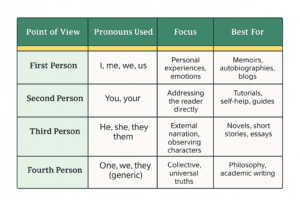
Each POV has its strengths and weaknesses, and the choice depends on the type of story or content you aim to create.
The fourth-person point of view offers a refreshing alternative to traditional storytelling. While its abstract nature and use of generic pronouns can be challenging, it opens up exciting possibilities for exploring universal truths and collective experiences. If you are writing a philosophical essay, crafting a self-help guide, or delving into abstract narratives, consider employing this POV. It will allow you to connect with readers on a broad, inclusive level.
If your content is ready, have our editors review it for clarity, relevance, and coherence. PaperTrue’s expert editing and proofreading services ensure your content comes across as professional and engaging. Let us help you bring your vision to life. Reach out today!
Here are some articles you might want to check out:
Found this article helpful?
 0
0
 0
0